• About
  • America’s Cup Guide
    • AC Guide & Calendar
    • America’s Cup World Series – Race Results & Standings
    • Teams – America’s Cup 2017
    • Rules – America’s Cup 2017
    • old AC Guide & Calendar
  • News
  • Videos
  • Search

Cup Experience

Many America's Cup fans say this is their best source of information.

  • About
  • America’s Cup Guide
    • AC Guide & Calendar
    • America’s Cup World Series – Race Results & Standings
    • Teams – America’s Cup 2017
    • Rules – America’s Cup 2017
    • old AC Guide & Calendar
  • News
  • Videos
  • Search

September 20, 2013 By Jack Griffin

Score: New Zealand 8 – USA 2

Oracle needs to win seven in a row.

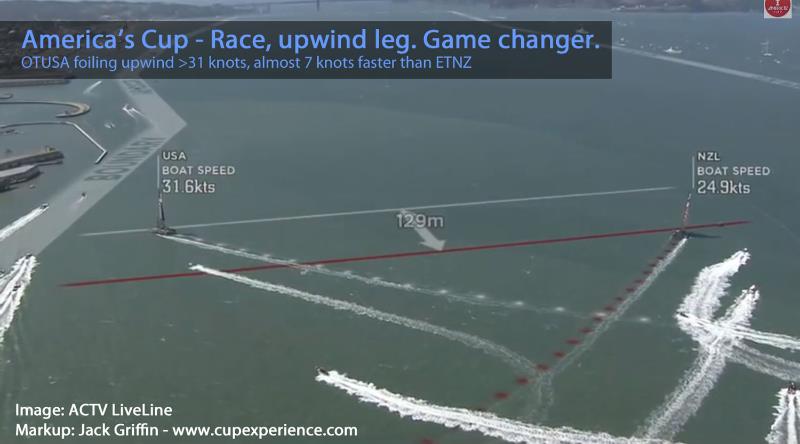
Oracle dominated the start of Race 12, then showed speed with upwind foiling. If that had been the first race, we would assume they would win 9-0. But now ETNZ only needs to win one of the next seven races to take the Cup.

Nine points are required to win the America’s Cup Match.
America's Cup Score: New Zealand 8 - USA 2
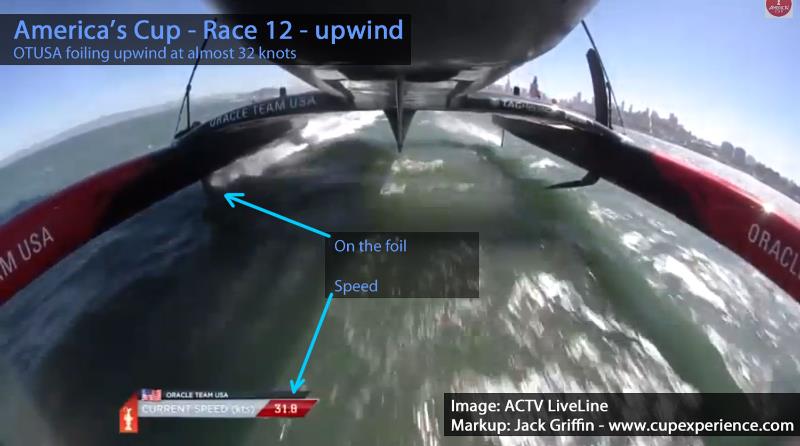
On the upwind leg OTUSA showed game-changing speed with upwind foiling over 30 knots.
America's Cup Score: New Zealand 8 - USA 2
The view from under OTUSA’s boat. They are on port tack, riding on the starboard daggerboard’s winglet. You can see the size of the winglet on the port daggerboard which is raised and out of the water.
America's Cup Score: New Zealand 8 - USA 2
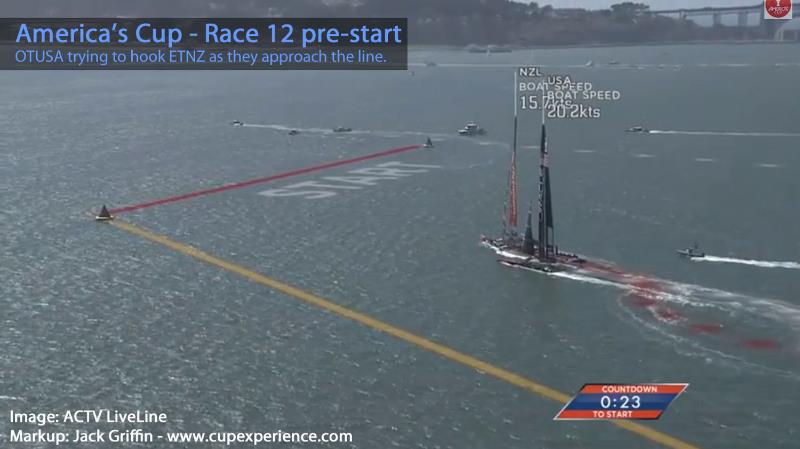
In the pre-start ETNZ seemed to be defending well, leading back to the line with 23 seconds to go.
America's Cup Score: New Zealand 8 - USA 2
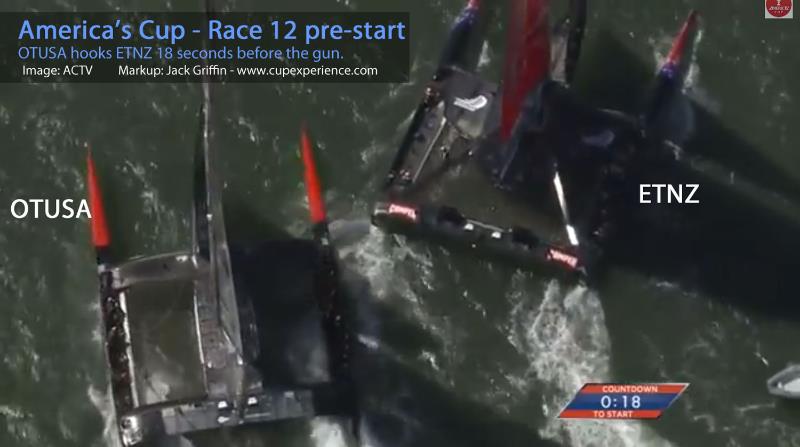
Approaching the line at 18 seconds to go, with both boats on starboard tack, OTUSA has “hooked” ETNZ, by getting an overlap to leeward. This gave OTUSA right of way, so they could luff ETNZ, forcing them to slow and tack onto port.
America's Cup Score: New Zealand 8 - USA 2
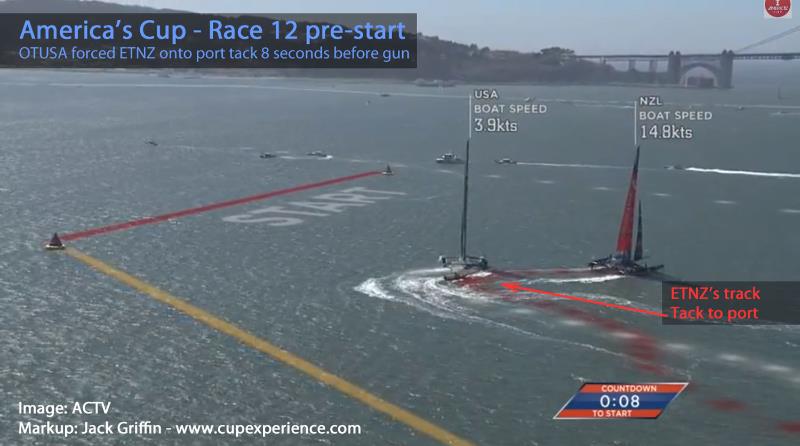
OTUSA’s luff forced ETNZ to tack onto port, heading away from the starting line. OTUSA is slow after the luff, but they bear away towards the line, build speed and lead on the reach to the first mark.

Dominating the start and foiling upwind – enough for a comeback?

If this had been the first race of the AC Match, most people would assume that OTUSA would dominate the Match and win 9-0. But now ETNZ takes the Cup if they win one more time, and OTUSA needs to win seven more, in a row. The comeback seems possible, but unlikely…

September 18, 2013 By Jack Griffin

Gary Jobson America’s Cup Report 12


Inner Strength at the America’s Cup

By Gary Jobson

Imagine what is going in the mind of Oracle Team USA’s Australian skipper, Jimmy Spithill. His team is down 8-1.  One more loss and the America’s Cup moves on to New Zealand for the second time in 18 years.   You might think the pressure is enormous, but I hope his focus is simply on winning the next race.  He can not think about the final result, the consequences, the disappointment, or his next gig.  Spithill needs to win the next start, then get ahead, and find a way to stay ahead.  If he does that, he can move on to the next race.  Skipper Spithill has many tools at his disposal including a boat that is even in speed with his rival,  the world’s most successful Olympic sailing champion as a tactician, a crew that is working their guts out, a design team and shore crew that keeps improving the speed of the boat, and the support of a very motivated owner.   Spithill can end up on the long list of losing America’s Cup skippers, or make the biggest comeback in the history of sailing.  It is all on his shoulders.  And, guess what?  We get to watch him go into battle in the biggest race (s) of his life.

In 1983 Spithill’s countrymen were down 1-3 against Dennis Conner in the America’s Cup.  The tenacious Aussies won 3 straight to take the Cup down under.  In 1920 the America defender was down 0-2 behind Shamrock IV in a best of 5 series.  The Americans won the last three races.  In 1934 Harold Vanderbilt’s Rainbow was down 0-2 in a best of 7 series.  The USA was behind in Race 3.  But clever tactics by Rainbow’s tactician, Sherman Hoyt, helped Rainbow take the lead on the final leg of the race.  The British never won another race.  Rainbow prevailed 4-2.  The stories of sports heroics are the stuff of legend.  If Spithill wins a race, and then another, and another the pressure will shift and put Emirates Team New Zealand in an increasingly defensive position.  Again, it will be great fun to watch.

Historically, September 18 has been a big day in the America’ Cup.  In 1930 Vanderbilt’s Enterprise defeated Shamrock V 4-0 to successfully defend.  In 1967, Intrepid swept Australia’s Dame Pattie 4-0.  Three of Intrepid’s crew would later become Commodores of the New York Yacht Club:  Skipper, Bus Mosbacher; bowman, George Hinman; and grinder, David Elwell.  And in 1977, Ted Turner and our crew aboard Courageous defeated Australia 4-0.  Our team stays in close contact.  We have a reunion every five years with full attendance.  How many teams can say that?

There is considerable talk around the San Francisco waterfront about the format and nature of the next America’s Cup.  Of course, no one from New Zealand will utter a word about anything on the horizon.  I will have a full discussion about the future of the America’s Cup in the November issue of Sailing World magazine.

I am not sure I should admit this, but I have been present at some part of the America’s Cup dating back to 1962 when I was 12 years old.  This event is in my bones.  I have been a member of five Cup crews over the years.  To this day I am grateful that Ted Turner gave me a chance to be his tactician.  Winning in 1977 was one of the greatest moments in the lives of our crew.   The 34th Defense is the 9th time I have served as a commentator on television.  The story lines never cease to amaze me. The behind the scenes work of our 92 person team has been special.  Every day we work hard to improve.  Covering sailing is not an exact science.  Most everyone on the team is an active sailor.  The aerial photography, on board cameras and microphones, amazing graphics, steady water view shots have been breathtaking.  How cool it is for Todd Harris,  Ken Read and me to interpret what is going on out on the water.  Thanks are in order to Oracle Corporation’s Larry Ellison for making this production a reality.

Occasionally, I am reminded that words count.  After racing was postponed on Tuesday I casually remarked while on the air to my partner Ken Read, that I had lined up 3 Lasers to go sailing that afternoon and that we should get our on air host, Todd Harris, on the water.  Within hours the Laser Class President, Tracy Usher, and several Laser greats including Chris Boome, Russ Silvestri, Nick Burke and Ron Witzel were lining up boats.  One of them even suggested that they should invite OTUSA’s Tom Slingsby to join us.  Tom has won the Laser Worlds and an Olympic Gold medal last summer.  Ken and I talked about showing up with a foiling Laser.

The 34th Defense of the America’s Cup might conclude on Thursday with a New Zealand victory in one of two scheduled races.  If Jimmy Spithill can dig down deep, find his inner strength and win on Thursday, he might be able to start running the table.  It would be the comeback of all time. What fun it will be to watch.

Our coverage continues LIVE on the NBC Sports Network at 4 pm ET, (1 pm PT).


September 16, 2013 By Jack Griffin

America’s Cup Race 10 last downwind leg


Use the Cup Experience LiveLine Race Viewer to analyze any part of any of the America’s Cup races.

Let’s look at the second downwind leg in Race 10 on Sunday 15 September, won by ETNZ.

In Race 10 of the America's Cup Match, Emirates Team New Zealand rounded the right mark at Gate 3 about one second behind Oracle Team USA who rounded the left mark. This gave ETNZ starboard advantage on the first cross going downwind. In Race 10 of the America’s Cup Match, Emirates Team New Zealand rounded the right mark at Gate 3 about one second behind Oracle Team USA who rounded the left mark. This gave ETNZ starboard advantage on the first cross going downwind.

At the first cross, OTUSA on port ducked ETNZ on starboard. Could they have crossed closer and kept the race closer? What would you do on an AC72 with a closing speed of 76 knots towards the right of way boat? This cross shows the extreme nature of AC72's in the America's Cup Match, At the first cross, OTUSA on port ducked ETNZ on starboard. Could they have crossed closer and kept the race closer? What would you do on an AC72 with a closing speed of 76 knots towards the right of way boat? This cross shows the extreme nature of AC72’s in the America’s Cup Match,

Blasting along the second downwind leg of Race 10 of the America's Cup Match, both AC72's were able to sail deep angles on starboard tack. Blasting along the second downwind leg of Race 10 of the America’s Cup Match, both AC72’s were able to sail deep angles on starboard tack.

ETNZ gybed onto port and crossed OTUSA easily, leading by about 200 meters. At this moment, there was nothing OTUSA could do to get back into the race. ETNZ gybed onto port and crossed OTUSA easily, leading by about 200 meters. At this moment, there was nothing OTUSA could do to get back into the race.

ETNZ gybed onto starboard at the layline for the last mark before the dash to the finish line. OTUSA needs one more gybe in this image.  With this win, ETNZ reclaimed the momentum i the 34th America's Cup Match. ETNZ gybed onto starboard at the layline for the last mark before the dash to the finish line. OTUSA needs one more gybe in this image.  With this win, ETNZ reclaimed the momentum i the 34th America’s Cup Match.

Use the Cup Experience LiveLine Race Viewer to view and analyze the races.


September 16, 2013 By Jack Griffin

Oracle drops off foils on Leg 1 of America’s Cup Race 10

Oracle Team USA lost Race 10 of the America’s Cup Match after dropping off their foils and splashing down on Leg 1. The speed loss allowed Emirates Team New Zealand to establish an overlap and the right to round Mark 1 in the inside lane.  Was the splashdown caused by the faster but less stable daggerboards OTUSA now uses?

Watch this excerpt from the ACTV video:


September 16, 2013 By Jack Griffin

Oracle speed modifications in America’s Cup Match


AC34-Race9-OTUSA-speed-mods

The AC72 catamarans are still being developed and improved, even as the competition proceeds. Emirates Team New Zealand skipper Dean Barker said after Race 10 that if they were still sailing their boat the way it was at the start of the Louis Vuitton Cup in early July, they would lose every race in the America’s Cup Match.

Oracle Team USA has made their boat dramatically faster upwind during the first week of the America’s Cup. They have removed the long bowsprit for the gennaker and the supporting kingpost and stay from the underside of the boat. They have also moved to different daggerboards, with the winglets set at an obtuse angle to the main board. These boards are faster but less stable. The boat is clearly faster upwind, but they did drop down off the foils in the first leg of Race 10, losing speed and allowing ETNZ to establish a critical overlap.

AC34-Race9-OTUSA-speed-mods-before-Race1-sprit
America’s Cup Defender Oracle Team USA continues to modify their AC72 during the America’s Cup Match, searching for more speed.

AC34-Race9-OTUSA-speed-mods-before-Race1


  • « Previous Page
  • 1
  • …
  • 85
  • 86
  • 87
  • 88
  • 89
  • …
  • 124
  • Next Page »
  • About
  • America’s Cup Guide
  • News
  • Videos
  • Search

Copyright © 2026 Cup Experience