• About
  • America’s Cup Guide
    • AC Guide & Calendar
    • America’s Cup World Series – Race Results & Standings
    • Teams – America’s Cup 2017
    • Rules – America’s Cup 2017
    • old AC Guide & Calendar
  • News
  • Videos
  • Search

Cup Experience

Many America's Cup fans say this is their best source of information.

  • About
  • America’s Cup Guide
    • AC Guide & Calendar
    • America’s Cup World Series – Race Results & Standings
    • Teams – America’s Cup 2017
    • Rules – America’s Cup 2017
    • old AC Guide & Calendar
  • News
  • Videos
  • Search

May 3, 2013 By Jack Griffin

Artemis removed the central cockpit from their AC72

In my earlier newsletter and blog post, I showed the dramatically different layout Artemis chose. While all three other teams put four grinding pedestals on each hull, Artemis opted for a central cockpit with two pedestals and two pedestals on each hull.
America's Cup Artemis AC72

They have now removed their central cockpit, but they have lost the two pedestals – they still only have two pedestals on each hull. They did modify the hulls, adding two winches and a cockpit for a trimmer in each hull. This gives us some clues about what their boat 2 will look like when it launches (in late May?). More photos and details here. And see the original layout compared with OTUSA, ETNZ and Luna Rossa here.
America's Cup Artemis AC72

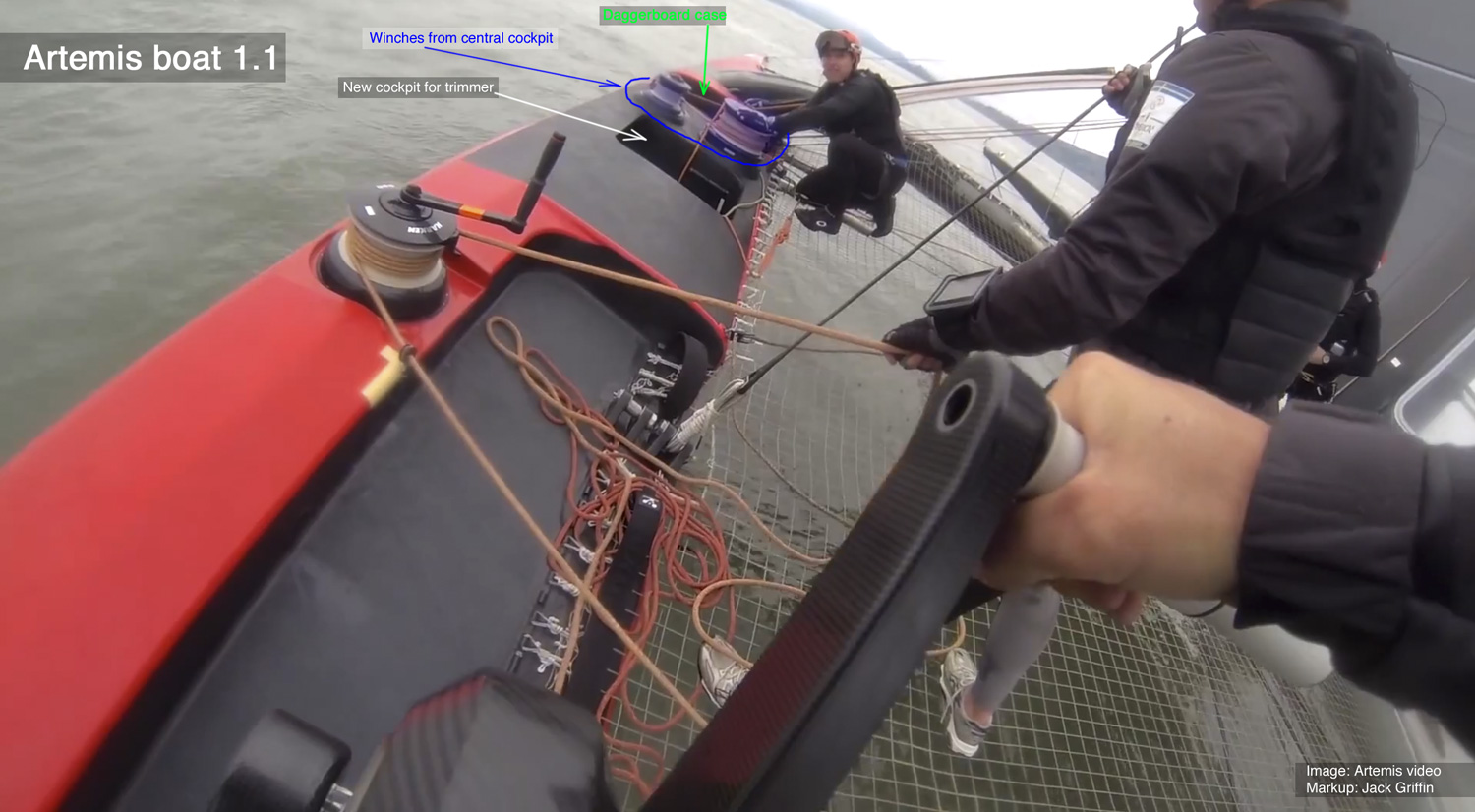
On board the modified Artemis AC72. The cockpit and the two winches furthest forward are new. Watch their video of the modified boat sailing here.


April 30, 2013 By Jack Griffin

AC72 design update Artemis ergonomics


Center cockpit – gone!

AC72-design-ergonomics-Artemis-cockpit1

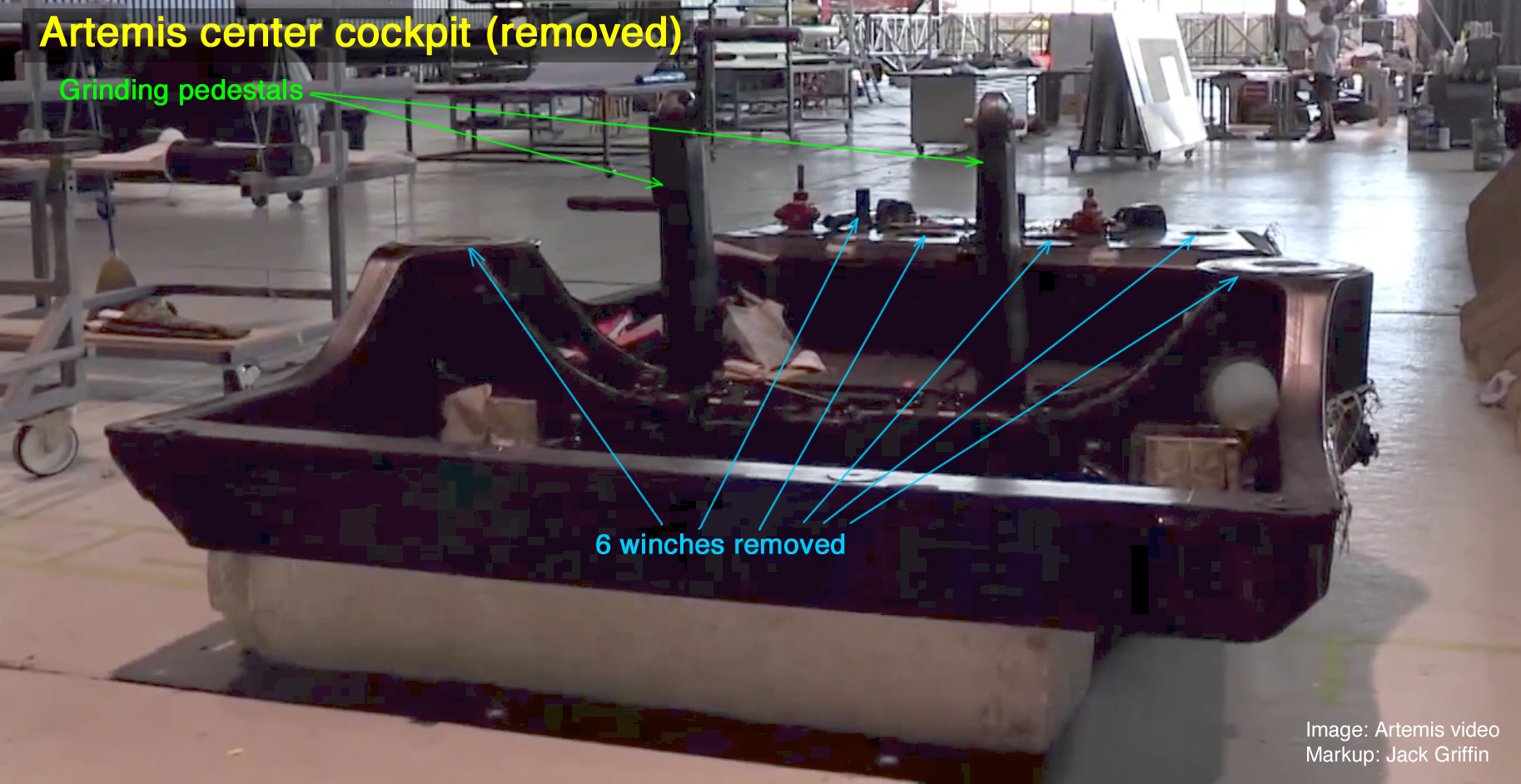
Artemis Racing, Challenger of Record for the America’s Cup, chopped the center cockpit out of their AC72. They repositioned 4 winches that were in that cockpit and eliminated two winches and the two grinding pedestals. Artemis now has a total of four grinding pedestals, compared to eight for all the other competitors.

AC72-design-ergonomics-Artemis-center-cockpit-scrap

The center cockpit had six winches and two grinding pedestals. Four of the winches have been moved, two to each hull, just behind the daggerboard case. The two grinding pedestals have been removed from the boat – maybe there was no place to put them in the current layout. My prediction: Artemis’s boat 2 will have at least three grinding pedestals per hull, and more likely, four per hull. The AC72 simply requires a lot of power to run all the controls.

AC72-design-ergonomics-Artemis-cockpit-gone

In the photo above we can see that the center cockpit has been removed, making it much easier for the crew to change sides during a tack or gybe. With the center cockpit we used to see the crew, including the helmsman, rolling under the wing to change sides.

America' Cup AC72 design - ergonomics. Artemis boat 1 before cockpit built in hull.

The photo above is “boat 1.0” – before the recent modifications. We see Nathan Outteridge with the tiller in his left hand. He is holding the traveller (aka “wing sheet”) in his right hand. The winch for the traveller is hidden, just forward of Nathan. There is another winch just forward of the crew at the grinding pedestal.

The photo below comes after the modifications – on what I call “boat 1.1.” You can see the two winches (circled in blue) that have been moved from the center cockpit. Just aft of them is the new cockpit for the trimmer. The winch on the red part of the hull was there before. It appears to be used for jib trim. The bigger winch forward of the new cockpit is probably for gennaker trim.

America' Cup AC72 design - ergonomics. Artemis boat 1 before cockpit built in hull.

See deck layouts from all the teams here.


April 29, 2013 By Jack Griffin

Big changes on Oracle’s new AC72


AC72-USA17b-leeward-foiling

Oracle Team USA launched their second AC72 last week. The big changes from their first boat go much deeper than the new color scheme. Probably the biggest change hidden – the foil control system. Originally, their AC72 design was for a “skimming” boat – one that did not lift completely out of the water. Boat 1 was not designed for “full foiling.” After learning that New Zealand was testing full foiling, the Oracle AC72 design for boat 1 was modified during construction to add foil control systems. The position of the daggerboards limited space and structural integrity to add a complete foil control system.

AC72-design-USA17a2-daggerboard-case
Boat 1 – daggerboard case forward of crossbeam

Compare these photos – in boat 2, the daggerboard case is aligned with the forward crossbeam and the opening is much bigger. No doubt there are much more advanced hydraulic controls in the hull and crossbeam of boat 2. The daggerboards can be tilted fore and aft, inboard and outboard. They may also have a control to twist them around their vertical axis. These adjustments are probably made by the helmsman, with control buttons on the wheel.

AC72-USA17b-board-case
Boat 2 – daggerboard case aligned with crossbeam

For comparison, look at the opening for the daggerboards on Emirates Team New Zealand boat 2. Their AC72 design began with the assumption of full foiling. You can see the foil control systems, including the buttons on the New Zealand wheel here.

AC72-design-ETNZ-daggerboard-case2
Emirates Team New Zealand designed their boats for full foiling.


April 29, 2013 By Jack Griffin

Big crash, confusing penalties in Naples

The final AC World Series event in Naples saw Francesco Bruni and Luna Rossa crash into Emirates Team New Zealand in their match race. Racing sailors would find the penalties confusing – the boat on starboard tack (ETNZ) was penalized and it took them most of the next leg to pay off their penalty. By that time they were 75m behind with only 300m to the final turning mark.

America's Cup Naples

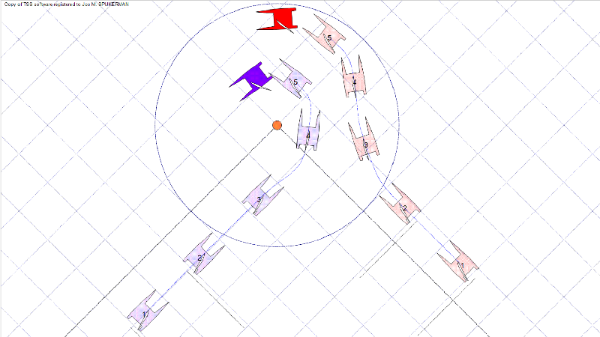
What happened? The Racing Rules of Sailing, America’s Cup Edition, have a very different rule about mark roundings. I explain this in the Video Briefing Room on the website – look at the video “Who can cut inside?” If you’re a rules geek like me, you can download the RRS AC Edition in the AC Guide section of the website.

What should have happened:

America's Cup penalties in Naples

(Thanks to Jos Spijkerman for the diagram. Learn more about the rules at his website.)

What did happen:

America's Cup penalties in Naples

ETNZ was penalized – a “boat on boat” penalty in a match race. Their penalty was to let Luna Rossa get two boat lengths ahead – precisely measured by the LiveLine system. But they compounded their penalty by gybing, which resulted in an additional two boat length penalty. See a complete sequence of images and more details here.

America's Cup penalties in Naples


April 26, 2013 By Jack Griffin

New Zealand – Luna Rossa crash & penalty in Naples

Luna Rossa won their match race against Emirates Team New Zealand in Naples after a crash at the windward gate. Bad news for ETNZ, and a good opportunity to see how penalties work. If you read my earlier article explaining the protest button and flashing lights on each boat, you’ll understand the signals on board the boats.

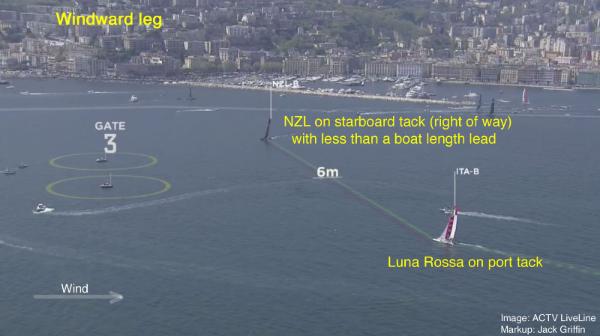
In the first picture, they are on the upwind leg. As they approach the gate from opposite sides of the course, NZL has right of way, as the starboard tack boat. They will reach the gate in about a minute – plenty of time for tactical decisions.  At the gate, they must sail between the marks and then round either one.

Here they have reached the three boat length zone around the marks, where special rules apply: if the boats are overlapped (which they are), when the first boat reaches the zone, the outside boat must give the inside boat “mark room” to round the mark. NZL has right of way, but must give room to Luna Rossa. It does not matter who has right of way. It does not matter who gets to the circle first. If there is an overlap, as soon as either of the boats enters the zone, the inside boat acquires mark room rights. You’ll find an explanation of the rule in my Video Briefing Room.

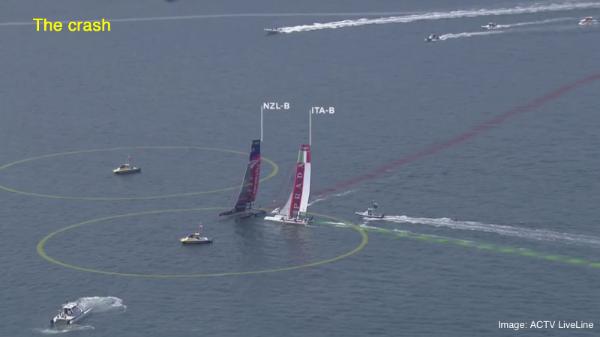
NZL did not leave room. Luna Rossa tried to go inside. CRASH!

The impact left Luna Rossa stopped, while NZL continued their rounding, still on starboard tack.

Both boats hit their protest button, signaling the umpires of the protest, and turning on the red protest light on their boat.

While the umpires make their ruling, NZL unfurls their gennaker and heads downwind. Luna Rossa gets going again and rounds the mark.

The blue light comes on for NZL signaling they were penalized. The umpire software mistakenly gave a “VMG penalty” instead of a “boat on boat penalty.” For a VMG penalty the penalized boat must slow down the equivalent of losing two boat lengths. As soon as the umpires saw the mistake, they cancelled the VMG penalty and signalled a boat on boat penalty:  When one boat fouls another while they are on the same leg, the penalized boat must let the fouled boat get two boat lengths ahead. (See Rule 44.2a and 44.2c). The LiveLine system calculates the penalty and keeps the blue light flashing until the penalty is paid off.

If a penalized boat makes a tack or a gybe while they are paying off a penalty, the penalty is increased by two boat lengths. Why? A boat slows down when turning in a tack or a gybe so a penalized boat could offload their penalty by making a turn they planned to make anyway. Look at NZL’s sails and their track in the next photo – you can see that they have gybed onto port.

NZL carried on down the leg on port, with Luna Rossa still at least four boat lengths behind. 

With the penalty light still on, NZL gybed again, shown in the next photo.

Luna Rossa then gybed, too, getting ahead of NZL, but still not two boat lengths ahead.

The penalty light on NZL went off momentarily when Luna Rossa got two boat lengths ahead.

And then the penalty light came back on, to signal the additional two boat lengths of penalty for making the second gybe. 

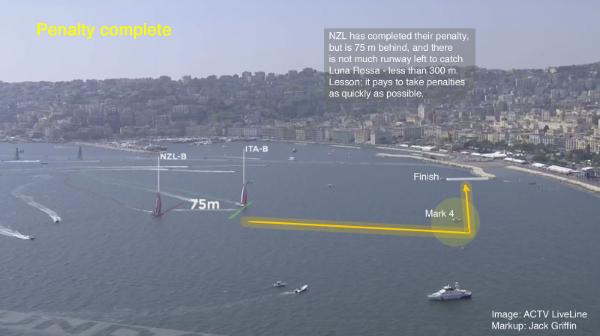
NZL now did what they should have done earlier – they slowed enough to pay off the penalty.

By the time NZL paid off the penalty, Luna Rossa had a 75m lead. With only about 300m to the final turning mark before the finish, NZL had no chance to catch up.  It’s not clear why they took so long to pay off the penalty, and why they chose to gybe twice, increasing the penalty. But now it should be clear to you how penalties work. Any questions?  Ask Jack!

  • « Previous Page
  • 1
  • …
  • 100
  • 101
  • 102
  • 103
  • 104
  • …
  • 124
  • Next Page »
  • About
  • America’s Cup Guide
  • News
  • Videos
  • Search

Copyright © 2026 Cup Experience