• About
  • America’s Cup Guide
    • AC Guide & Calendar
    • America’s Cup World Series – Race Results & Standings
    • Teams – America’s Cup 2017
    • Rules – America’s Cup 2017
    • old AC Guide & Calendar
  • News
  • Videos
  • Search

Cup Experience

Many America's Cup fans say this is their best source of information.

  • About
  • America’s Cup Guide
    • AC Guide & Calendar
    • America’s Cup World Series – Race Results & Standings
    • Teams – America’s Cup 2017
    • Rules – America’s Cup 2017
    • old AC Guide & Calendar
  • News
  • Videos
  • Search

May 25, 2013 By Jack Griffin

The new racing calendar?


The safety recommendations call for eliminating two rounds robin – that means six days. What will that do the racing calendar? The objective is to give the challengers more time for maintenance.  Let’s assume ACRM wants…

  • to minimize the number of times any team races two days in a row
  • to change only the round robin phase; leave all other dates unchanged
  • to keep the existing order of racing, as far as possible
  • to hold races on Saturdays and Sundays

Here’s how they could do it with minimum change:

  • eliminate racing on Wednesdays and Fridays
  • race on Thursdays
  • reverse the order of the first two races of RR3
  • eliminate the last weekend of the round robin

This way each team has one weekend when they race both days. Otherwise every race day is followed by at least one day off. It also gives the teams a longer break before the start of the Louis Vuitton Cup Semi-final.

Here’s what the calendar would look like in July:

And here is the existing calendar it would replace:

Current race calendar for July. This will change - two rounds robin to be deleted. Current race calendar for July. This will change – two rounds robin to be deleted.

August and September dates remain unchanged, although race start times may be earlier due to the new, lower wind limits.

Start times likely to change due to new, lower wind limits. Start times likely to change due to new, lower wind limits. Start times likely to change due to new, lower wind limits. Start times likely to change due to new, lower wind limits.


May 25, 2013 By Jack Griffin

Recommendations or Rules?

Safety Recommendations from the Regatta Director have the force of rules.

Oracle Team USA AC72 capsized on their eighth sailing day. Oracle Team USA AC72 capsized on their eighth sailing day.

Four teams have sailed AC72 catamarans on San Francisco Bay. Two of them have capsized, one fatally. Regatta Director Iain Murray issued his safety recommendations on 22 May 2013.

The recommendations became part of the application to the US Coast Guard for the “Marine Event Permit” for this summer’s racing. Assuming the Coast Guard issues the permit, the recommendations effectively become “requirements” – part of the regulations that apply to this America’s Cup. Article 16 of the Protocol for the 34th America’s Cup requires teams to comply with “applicable laws and regulations.”

Safety recommendations trump the Protocol, the AC72 Class Rule and the Measurement Committee.

Here are some examples of how the safety recommendations take precedence.

  • Safety Recommendation 4.4 calls for lower wind limits than the ones in article 22.1 of Protocol.
  • Safety Recommendation 4.9 eliminates the $100,000 fine for not racing specified in article 21.2d of the Protocol.
  • Safety Recommendation 1.3d specifies rudder elevators that extend beyond the maximum beam, conflicting with the AC72 Class Rule article 5.5.
  • Safety Recommendation 1.3e permits adjusting the rudder elevators until the warning signal, conflicting with Public Interpretation 19 of the Measurement Committee.

A “clarification” – transparent wings?

The recommendation that “soft coverings and soft fairings” should be transparent does not apply to the wings. All of the teams have large transparent lower sections in their wings, which apparently satisfies Regatta Director Iain Murray.

What about training?

All the above applies to racing. The recommendations remain “recommendations” during training. If a team wants to train in more than 23 knots of wind, there is nothing to stop them. Recommendations 3.2 and 3.3 call for two rescue boats to support each AC72, each rescue boat with a diver and a rescue swimmer. That means Oracle Team USA should have four rescue boats, each with a diver and a rescue swimmer, when they do two boat testing.

If the teams follow the recommendations during training, they will reduce the risk of more AC72 capsizes and should improve the sailors’ safety during and after a capsize.

America's Cup Safety Recommendations America’s Cup Safety Recommendations 34th America's Cup Protocol 34th America’s Cup Protocol America's Cup AC72 Class Rule America’s Cup AC72 Class Rule

May 24, 2013 By Jack Griffin

AC72 sailing resumes on SF Bay


Some big firsts yesterday: first day to have three AC72 catamarans together on San Francisco Bay and the first day for Emirates Team New Zealand to sail their AC72 on the bay. Click to watch their video.

Luna Rossa's AC72 training for the America's Cup on San Francisco Bay. Photo: Carlo Borlenghi Luna Rossa’s AC72 training for the America’s Cup on San Francisco Bay. Photo: Carlo Borlenghi

Click to watch the video, with all three teams.


May 24, 2013 By Jack Griffin

Safety recommendations announced


America’s Cup Regatta Director Iain Murray presented 37 safety recommendations including wind limits 10 knots lower for racing and eliminating the guest racers. These recommendations now form part of the safety plan submitted to the US Coast Guard in order to have the Marine Event Permit issued.


Iain presented the recommendations to the four teams on Wednesday 22 May. All teams cooperated with the Safety Review committee. Emirates Team New Zealand has said they support the recommendations, calling them “prudent and reasonable.” Luna Rossa was less enthusiastic, saying they appreciate the efforts of the Review Committee, but they then ignored the committee’s recommendation to suspend AC72 sailing last week. They sailed their AC72 for the first time on San Francisco Bay, sailing comfortably in light winds (3 knots) that increased to 12 knots and foiling.

Photo: Carlo Borlenghi Photo: Carlo Borlenghi
The recommendations include allowing adjustable stabilizers (incorrectly called “elevators” in the Safety Recommendations). Adjustable stabilizers on the rudders would help prevent pitchpoles – the stabilizers could be adjusted up until the warning signal for a race but not during racing. This would let the crews set up the pitch to match the conditions. Another recommendation is to award the race immediately to a yacht if their competitor capsizes, rather than requiring them to sail over the course. This would allow all effort to be concentrated on the capsized yacht.

Spectators will be affected: lower wind limits could result in delays. Recommended buffer zones could move the racing farther from shore. There will be six fewer race days, since the round robin phase will be reduced to allow more time for maintenance.


May 17, 2013 By Jack Griffin

Luna Rossa’s AC72 in California

While the safety Review Committee does its work, teams continue with their preparations for racing, scheduled to begin July 5. Luna Rossa has done load testing on their AC72 at their temporary base in Alameda.

America's Cup Luna Rossa's AC72 in California

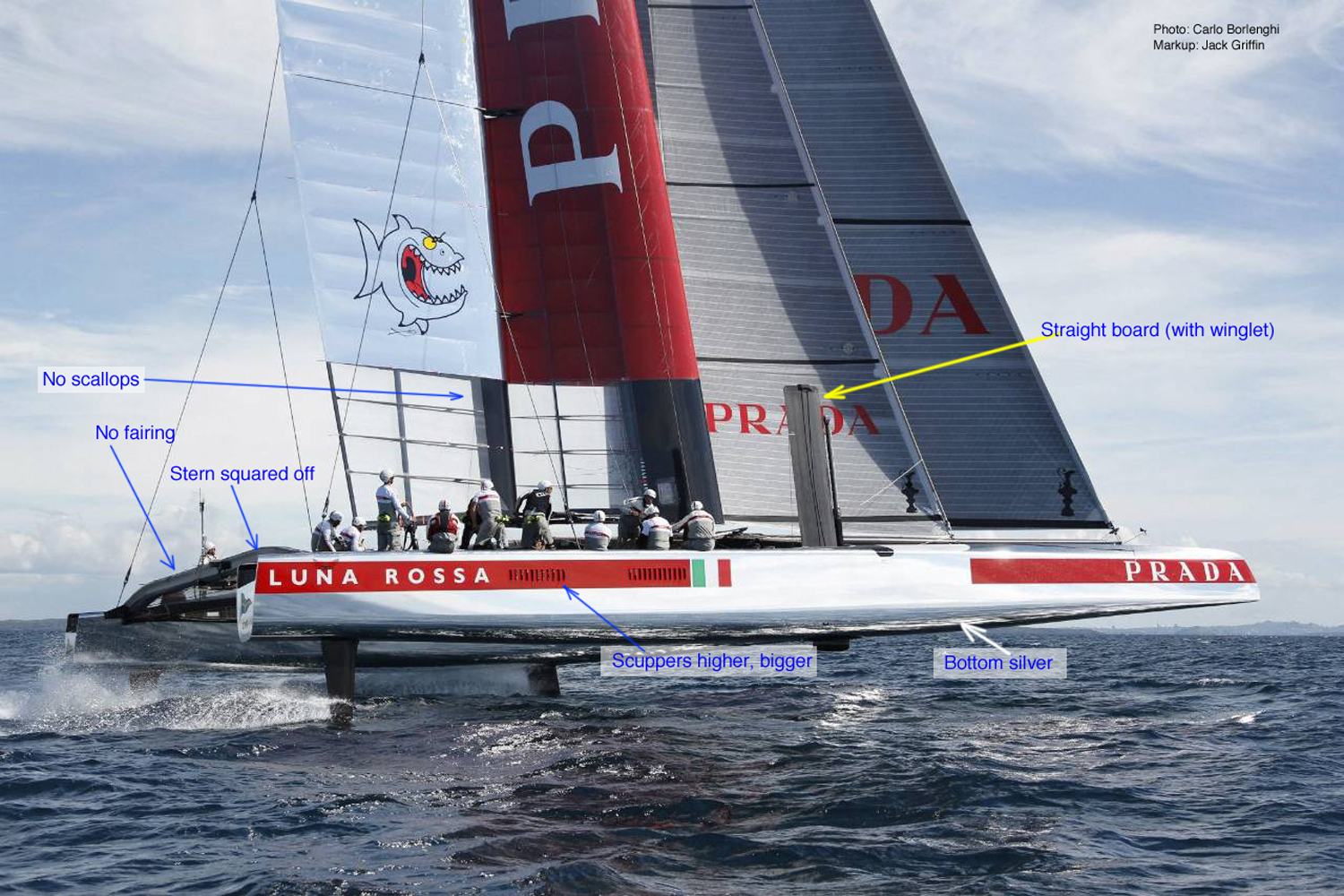
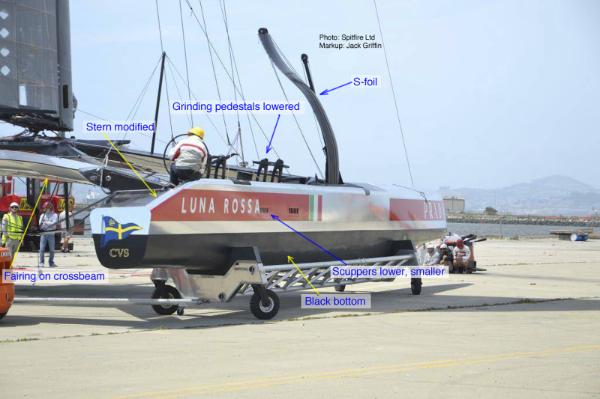
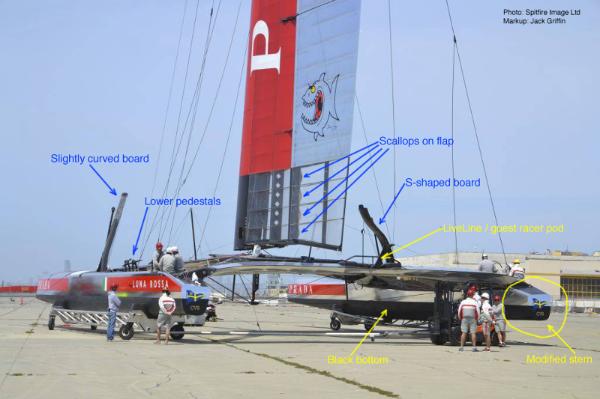
In the photo above, we see that they have modified the stern, changed the size and location of the scuppers (drain holes) and lowered the grinding pedestals. I noted in an earlier article that Emirates Team New Zealand also lowered the grinding pedestals in their boat. Luna Rossa also has a new look – the lower half of the hull is now black. Assuming their dramatic silver finish is some kind of glue on foil, this could be a weight saving move. We saw the fairing on the rear crossbeam in photos from Auckland, but now they have integrated the pod for LiveLine electronics and the guest racer.

America's Cup Luna Rossa's AC72

In the photo above, we see an S-shaped foil in the starboard hull and a slightly curved foil on the port side.

The “before” photo

America's Cup Luna Rossa foiling in Auckland

Luna Rossa foiling in Auckland, before the modifications. On this day they had a straight board in the starboard hull. You can see the original location of the scuppers, the old stern shape and the rear crossbeam before the fairing was added. That all silver finish was very stylish, too!

  • « Previous Page
  • 1
  • …
  • 98
  • 99
  • 100
  • 101
  • 102
  • …
  • 124
  • Next Page »
  • About
  • America’s Cup Guide
  • News
  • Videos
  • Search

Copyright © 2026 Cup Experience