• About
  • America’s Cup Guide
    • AC Guide & Calendar
    • America’s Cup World Series – Race Results & Standings
    • Teams – America’s Cup 2017
    • Rules – America’s Cup 2017
    • old AC Guide & Calendar
  • News
  • Videos
  • Search

Cup Experience

Many America's Cup fans say this is their best source of information.

  • About
  • America’s Cup Guide
    • AC Guide & Calendar
    • America’s Cup World Series – Race Results & Standings
    • Teams – America’s Cup 2017
    • Rules – America’s Cup 2017
    • old AC Guide & Calendar
  • News
  • Videos
  • Search

November 25, 2013 By Jack Griffin

Oracle Team USA’s daggerboard control system

In July, OTUSA was not able to do foiling gybes as consistently as Team New Zealand. They were losing about 150 meters on their “good” gybes, and they felt they needed to get that down to about 30 meters. By early August, their engineers had developed a new foil control system that allowed them to gybe smoothly.

Using a “mechanical feedback loop” helmsman Jimmy Spithill was able to change the angle of the daggerboards in increments of 0.5° giving dramatically more stable foiling.

Lots more details and marked up photos and diagrams here.
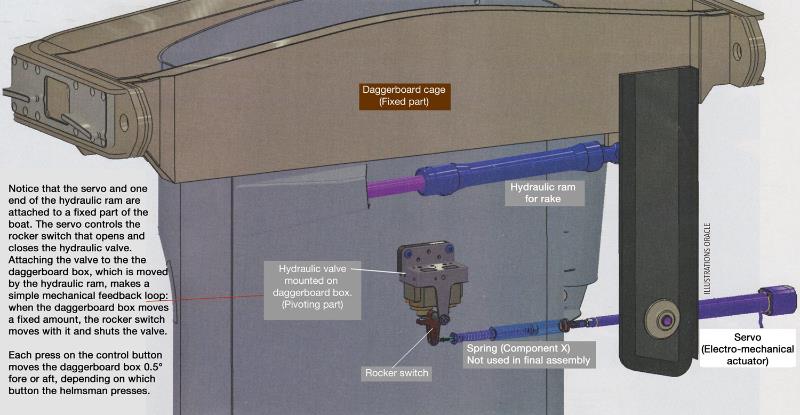
America's Cup Oracle Team USA's daggerboard control system

Mounting the hydraulic valve on the movable daggerboard box, and the servo that controlled it on the fixed part of the boat allowed the helmsman to adjust the boards very precisely. More info here.
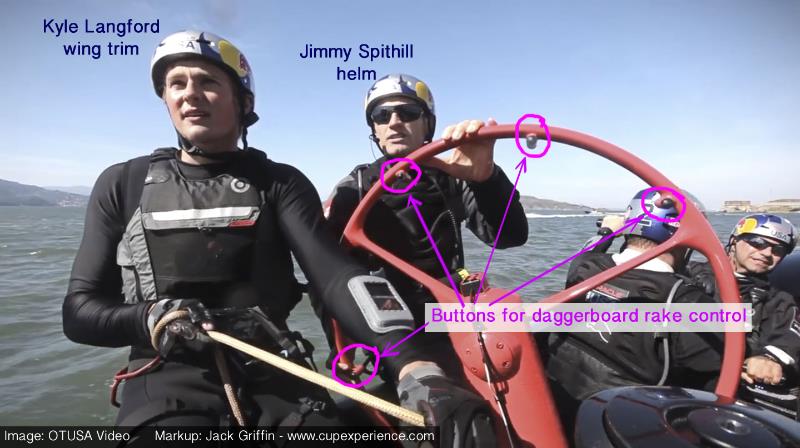
America's Cup Oracle's helmsman Jimmy Spithill

Each press on the buttons changed the daggerboard rake by 0.5° – precise control for stable hydrofoiling.
November 25, 2013 By Jack Griffin

The upwind legs were key to winning the America’s Cup

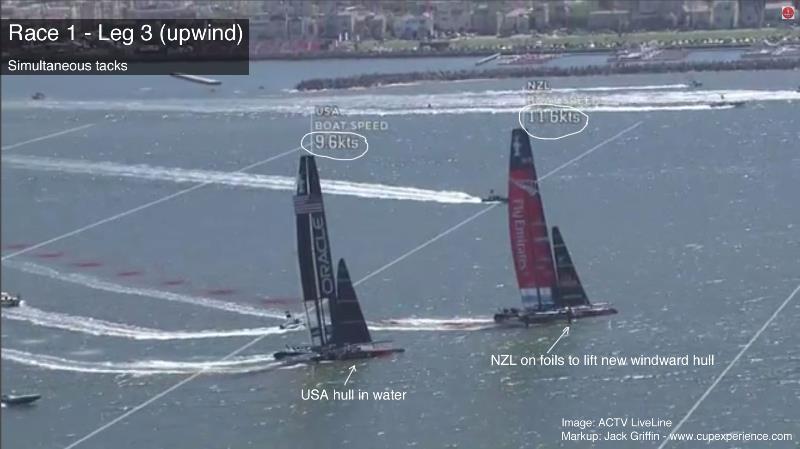
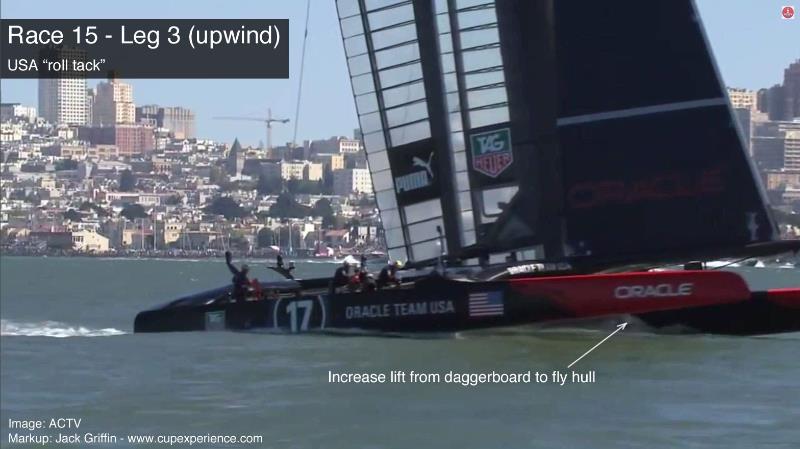
Oracle Team USA expected their slippery aerodynamic shape to give the the edge upwind. They were surprised that Team New Zealand had more speed upwind. Team New Zealand was much faster through the tacks until about Race 8 when Team USA had mastered “roll tacking” – using their foils to lift the bows.

America's Cup Oracle Team USA roll tacking

In the early races Team USA was slow through their tacks, pushing a lot of water sideways. By Race 8 they dramatically improved their tacking.

America's Cup Oracle Team USA roll tack

Team USA learned to use their foils to lift their bows in a “roll tack.”

November 6, 2013 By Jack Griffin

Race 10 tactical decisions


America’s Cup Race 10, won by Emirates Team New Zealand

In Race 10, OTUSA made two tactical decisions that both turned out badly, and ETNZ went on for the win. Let’s look at these two situations. 

After swapping the lead twice on the upwind leg, ETNZ sailed high and slow, to be able to duck OTUSA and still lay the right hand mark at Gate 3. With starboard advantage, OTUSA might have slowed down to prevent ETNZ from laying the mark. Or they might have tacked in front of ETNZ and rounded the right hand mark – Rule 18 gave them rights to mark room. Instead, they maintained speed, crossed in front and rounded the left hand mark, giving ETNZ the right side and starboard advantage on the downwind leg.


September 20, 2013 By Jack Griffin

Score: New Zealand 8 – USA 2

Oracle needs to win seven in a row.

Oracle dominated the start of Race 12, then showed speed with upwind foiling. If that had been the first race, we would assume they would win 9-0. But now ETNZ only needs to win one of the next seven races to take the Cup.

Nine points are required to win the America’s Cup Match.

America's Cup Score: New Zealand 8 - USA 2
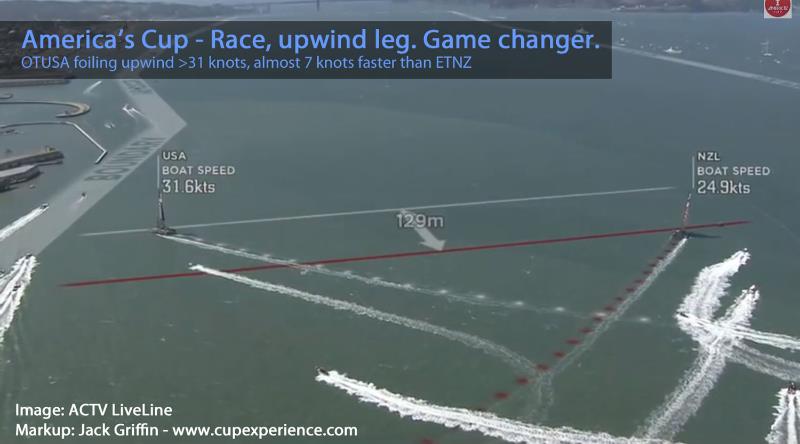
On the upwind leg OTUSA showed game-changing speed with upwind foiling over 30 knots.
America's Cup Score: New Zealand 8 - USA 2
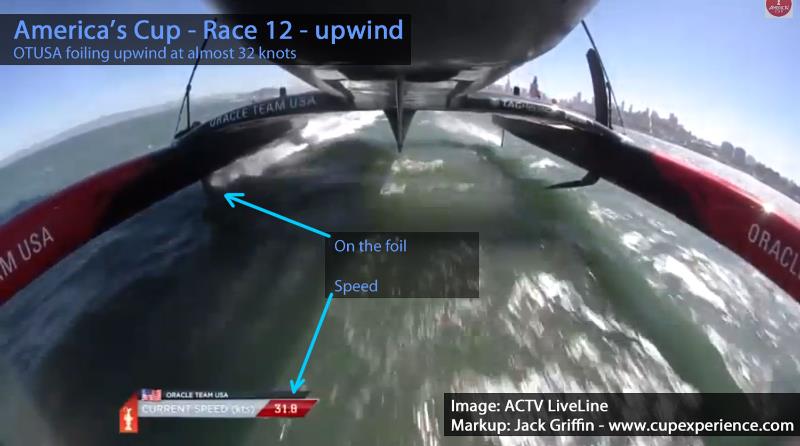
The view from under OTUSA’s boat. They are on port tack, riding on the starboard daggerboard’s winglet. You can see the size of the winglet on the port daggerboard which is raised and out of the water.
America's Cup Score: New Zealand 8 - USA 2
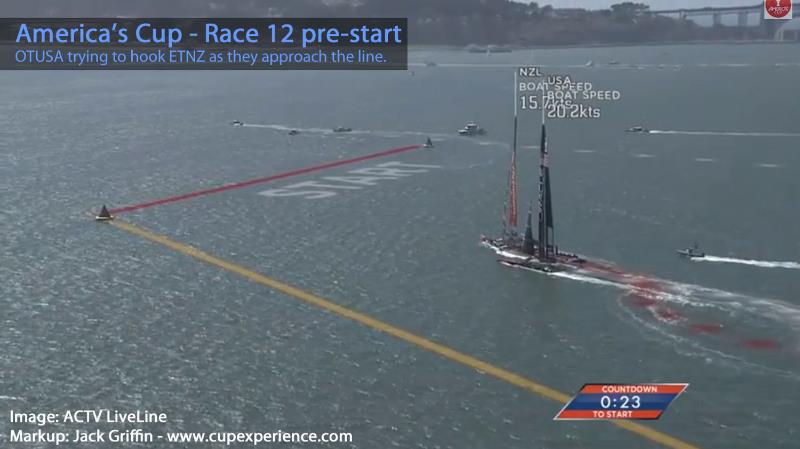
In the pre-start ETNZ seemed to be defending well, leading back to the line with 23 seconds to go.
America's Cup Score: New Zealand 8 - USA 2
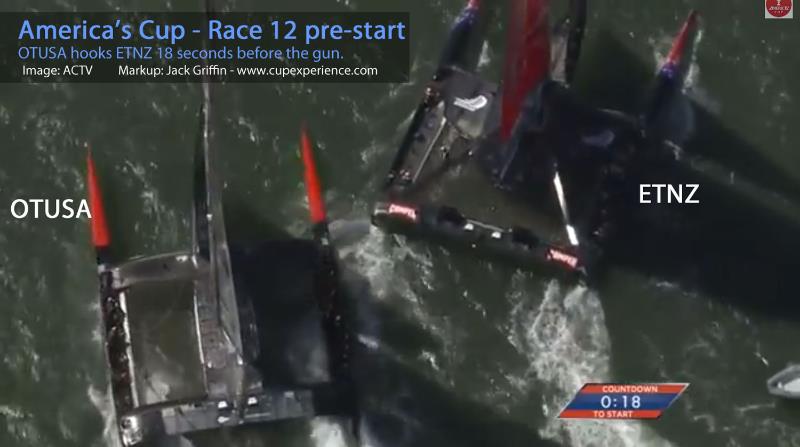
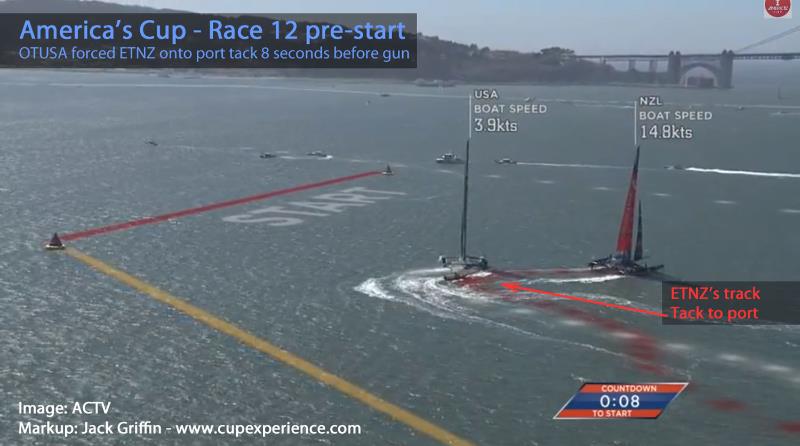
Approaching the line at 18 seconds to go, with both boats on starboard tack, OTUSA has “hooked” ETNZ, by getting an overlap to leeward. This gave OTUSA right of way, so they could luff ETNZ, forcing them to slow and tack onto port.
America's Cup Score: New Zealand 8 - USA 2
OTUSA’s luff forced ETNZ to tack onto port, heading away from the starting line. OTUSA is slow after the luff, but they bear away towards the line, build speed and lead on the reach to the first mark.

Dominating the start and foiling upwind – enough for a comeback?

If this had been the first race of the AC Match, most people would assume that OTUSA would dominate the Match and win 9-0. But now ETNZ takes the Cup if they win one more time, and OTUSA needs to win seven more, in a row. The comeback seems possible, but unlikely…

September 16, 2013 By Jack Griffin

Race Schedule

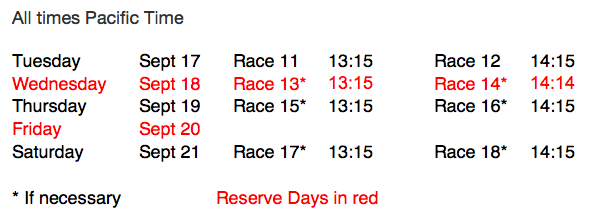
Emirates Team New Zealand needs to win two more races to score nine points and take the America’s Cup. With their three race wins, Oracle Team USA erased their two point penalty and scored one point. They need to win eight more races to defend and keep the Cup. Two scheduled races were not sailed: OTUSA used their “postponement card” to cancel the second race on Tuesday, September 12. The second race on Saturday, September 14 was abandoned because the wind limits were reached.

The broadcast schedule is available here. The schedule of remaining races is:

America's Cup Race Schedule

  • « Previous Page
  • 1
  • …
  • 28
  • 29
  • 30
  • 31
  • 32
  • …
  • 35
  • Next Page »
  • About
  • America’s Cup Guide
  • News
  • Videos
  • Search

Copyright © 2026 Cup Experience