• About
  • America’s Cup Guide
    • AC Guide & Calendar
    • America’s Cup World Series – Race Results & Standings
    • Teams – America’s Cup 2017
    • Rules – America’s Cup 2017
    • old AC Guide & Calendar
  • News
  • Videos
  • Search

Cup Experience

Many America's Cup fans say this is their best source of information.

  • About
  • America’s Cup Guide
    • AC Guide & Calendar
    • America’s Cup World Series – Race Results & Standings
    • Teams – America’s Cup 2017
    • Rules – America’s Cup 2017
    • old AC Guide & Calendar
  • News
  • Videos
  • Search

January 9, 2014 By Jack Griffin

Book review: “Winging It” – 2013 America’s Cup in San Francisco


WinginItCover-compressed

Whether you are a casual fan or a die-hard America’s Cup follower, you’re likely to enjoy “Winging It.” The three authors – all accredited journalists who spent many, many hours in the America’s Cup Media Center – will take you from the origins of the America’s Cup in 1851 all the way through Oracle Team USA’s incredible comeback in San Francisco in September 2013.

If you are watching replays of the races, Chapter 12 provides an excellent guide for each of the 19 races. You’ll understand better how Emirates Team New Zealand jumped out to an 8-1 lead and how OTUSA climbed a steep learning curve to improve their boat handling and speed, and how they came back with eight straight wins in their improbable defense of the America’s Cup. The six charts on pages 213-214 tell the tale succinctly, graphing the tacking angles and speeds of both teams.

Chapter 7 and Chapter 10 will guide you through the Louis Vuitton Cup racing, including the Artemis team’s gutsy but losing performance in the semi-final. Chapter 6 gives a respectful treatment of the loss of Andrew Simpson in Artemis’s capsize while training in May 2013

Chapter 3 explains how and why the decision was made to create a new class – the AC72 – to ensure that the America’s Cup would be raced in the most advanced boats. And, in Chapter 8 you’ll learn how ETNZ led the way to hydrofoiling. The diagrams and clear explanations on page 117 show you how the daggerboards get these seven ton monsters flying.

Chapter 1 breaks new ground telling the history of the America’s Cup. It explains how this tradition bound event evolved to be raced at speeds over 40 knots in hydrofoiling yachts and why the high tech AC72 wingsail catamarans reflect the roots and history of the competition. There is a recap of the rapid, sometimes painful evolution from 1983 onwards, a period that included two bitter, multi-year lawsuits, seven different types of yachts and five different challengers successfully wresting the America’s Cup from the hands of the previous defender. Most of the earlier history is succinctly distilled into five reasons why the New York Yacht Club was able to hold the trophy from 1851 to 1983 – the longest winning streak in sports.

Winging It 
McGraw-Hill Professional/International Marine, 224 pages with 37 b/w photos, 12 charts and illustrations

Order it on Amazon.

Official website for the book—

Winging It: Oracle Team USA’s Incredible Comeback to Defend the America’s Cup
by Diane Swintal, R. Steven Tsuchiya, and Robert Kamins

Table of Contents:
Acknowledgments – vi
Introduction: A Cup Like No Other – 1

Chapter One – Challengers and Defenders:
A Brief History of the America’s Cup – 4
The Yacht America and the Dawn of the America’s Cup  – 4
Five Reasons the New York Yacht Club Held the Cup from 1851 to 1980 – 6
Australia II Wins the Cup (1983) – 11
A New World: 1983 to Present – 15
Sidebar: Significant Changes in the America’s Cup Since 1983 – 17

Chapter Two – Defending the 34th America’s Cup
Picking Up the Cup – 29
Sidebar: Visions of a New Cup – 34

Chapter Three – Finalizing the Vision for the 34th America’s Cup
Boats, Teams, and Venues – 37
Boats for 2013 – 37
Sidebar: Interview with Pete Melvin on the AC72 Rule – 44
Announcing the New Cup – 45
Team Formation for 2013 – 48
Sidebar: Making the Multihull Decision: Pete Melvin – 57
Selecting the Venue – 63
Sidebar: Stan Honey—Sailing on TV – 65

Chapter Four – America’s Cup World Series
—Sailing the AC45s – 68
Sidebar: Emirates Team New Zealand Works Up to Sailing the AC72s – 69
Sidebar: AC45s Help Shore Crews Prepare for 72s – 71
Sidebar: ETNZ’s Chase 1—Keeping Up with the AC72s – 75

Chapter Five – ORACLE TEAM USA’s AC72s
OTUSA Prepares for the AC72 – 78
Sidebar: AC72—Big Data Goes Sailing – 80
Sidebar: Recruiting Talent to the AC – 83
OTUSA’s AC72 Capsize – 84

Chapter Six – Artemis Capsize and the Loss of Andrew Simpson – 95
Artemis Resilience – 99
Accident Aftermath – 100

Chapter Seven – Louis Vuitton Cup Racing Begins – 104
Round Robins: July 4 to August 1 – 104
Sidebar: New Crewing Opportunities – 107
Louis Vuitton Cup Semi-Final, August 6 to 15 – 110

Chapter Eight – Sailing the AC72—Foiling – 113
The Foils – 115
How They Do It – 116
Development of the Foiling Concept – 118
Testing and Development in the AC – 119
Trickle Down—Other Foiling Sailboats – 120
Sidebar: Cup-Speak – 122
Helming an AC72: “It’s Hyper” – 123

Chapter Nine – ORACLE TEAM USA’s Penalty – 124

Chapter Ten – Louis Vuitton Cup Finals – 130
August 17 to 30: A Best of 13 Series – 130

Chapter Eleven – A Team of Rivals—OTUSA Trains with Two Boats – 145

Chapter Twelve – America’s Cup Match: The 34th Defense of the America’s Cup – 149
The Match – 151
The Racing – 152
How They Did It – 190

Epilogue – The Next America’s Cup – 198
Teams for the 35th America’s Cup – 199
Cats are Loose—Where Do We Go from Here? – 202
Notes – 207

Appendix – 209
Deed of Gift
America’s Cups Winners
AC72 Diagram
Tacking Charts
Match Point Summary

Index – 216
 

December 5, 2013 By Jack Griffin

More on Team USA’s daggerboard control system

In addition to the buttons on the wheel allowing Jimmy Spithill to control daggerboard rake, grinder Simeon Tienpont had controls. In his cockpit, pushbuttons on the sole (floor) and a control panel on the side allowed him to control daggerboard height, cant (angle side to side) and rake (angle fore and aft).

My article on the daggerboard control system has been featured in lots of places, from a Swedish sailing blog to TV3 in New Zealand. Watch the clip from TV3 here.

I’ve updated the labels on the photos in the article, to be more consistent describing the daggerboard box and the daggerboard cage.

Lots more details and marked up photos and diagrams here.

America's Cup Board Control Test Bed
America’s Cup Board Control Test Bed

December 5, 2013 By Jack Griffin

Video – Tacking faster – key to the Comeback

Team USA’s learned “to roll tack” during the America’s Cup Match

In the early races, Team USA was pushing a lot of water sideways in their tacks. And, they were about 4-5 knots slower than Team New Zealand in a tack. They learned to lift the leeward bow out of the water at the beginning of a tack, and “roll tack” onto the other hull. The first time they used the roll tack was in Race 8. With more pressure on them in the upwind leg, TNZ almost capsized. Watch this video to see Team USA’s improvement. 

November 25, 2013 By Jack Griffin

Video of Oracle Team USA tacking the AC72 faster


Faster tacks were key to Oracle Team USA’s comeback in the 2013 America’s Cup

Watch this video to see how Team USA improved their tacking to come back from 1-8 down and beat Team New Zealand in the America’s Cup 9-8.


November 25, 2013 By Jack Griffin

Foil control system on Oracle’s AC72


AC72 foil control secrets

Some people have questioned whether Oracle Team USA had a secret (and illegal) foil control system in their AC72 that helped them defend the America’s Cup.

OTUSA has released drawings and photos of their system, which used a simple “mechanical feedback” loop to allow precise control of the daggerboard rake. Helmsman Jimmy Spithill had buttons on the wheel to rake the daggerboard fore and aft in precise increments of 0.5° giving him better control over lift for hydrofoiling.

PI49-3D-view

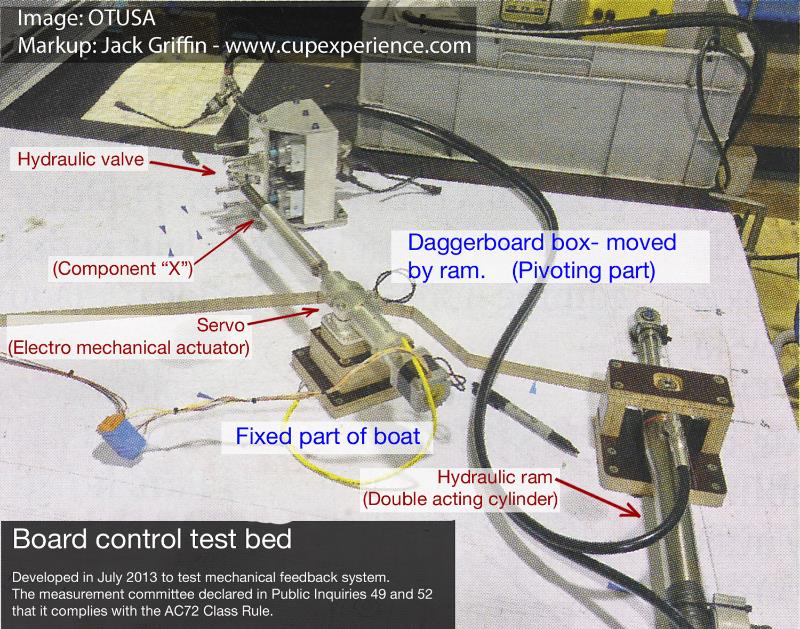
OTUSA designers Dimitri Despierres (mechanical systems) and Eduardo Aldaz Carroll (electronic systems) began work in late June 2013 to help the team gybe better. The goal was to reduce distance lost in a gybe from 150 meters to 30 meters. To do this the engineers needed to deal with the problem that board movement varied depending on hydraulic pressure, making it impossible to control lift. What they needed was a way to move the board a fixed amount independent of the pressure and drag load on the board. Within a month, mechanical engineer Alex Davis developed a test bench with a servo control, hydraulic valve and hydraulic ram to simulate movement of the daggerboard box (see photo below).

OTUSA-test-bed-foil-control

Once the test bed system worked, the system was tested on board. Accuracy was fine, but it reacted too slowly. Mechanical engineer Neil Wilkinson and hydraulics specialist Rolf Engelberts improved the system to improve response speed and make everything more reliable and robust.

AC72-Oracle-R14-L2-both-buttons

AC72 daggerboard controls on OTUSA Boat 1

The hydraulic ram for rake is not visible in the photo below, but you can see the rams for board cant, as well as the daggerboard cage and daggerboard box. The box moves within the cage, which is fixed in the hull.

AC72-design-foil-control-OTUSA-b1'

Rendering of AC72 daggerboard cage below. The cage is fixed in the hull. The daggerboard box moves fore / aft (rake) within the daggerboard cage. The daggerboard cage moves inboard / outboard (cant) within the hull.

AC72-daggerboard-cant

Controversy and protest by Team New Zealand

OTUSA wanted to make sure their system complied with the AC72 Class Rule. They filed a “Public Inquiry” to the Measurement Committee and got approval on 8 August 2013 – only a month before the America’s Cup Match was to begin. Team New Zealand then tried to have OTUSA’s system ruled illegal but the Measurement Committee stood by their initial decision and the International Jury ruled that New Zealand’s protest was made too late, but would not have succeeded even if it had been filed on time. The marked up schematic below was part of Team New Zealand’s submission. OTUSA eliminated the spring labeled “Component X” making the TNZ protest moot.

AC72-OTUSA-foil-control-PI52


  • « Previous Page
  • 1
  • …
  • 27
  • 28
  • 29
  • 30
  • 31
  • …
  • 35
  • Next Page »
  • About
  • America’s Cup Guide
  • News
  • Videos
  • Search

Copyright © 2026 Cup Experience