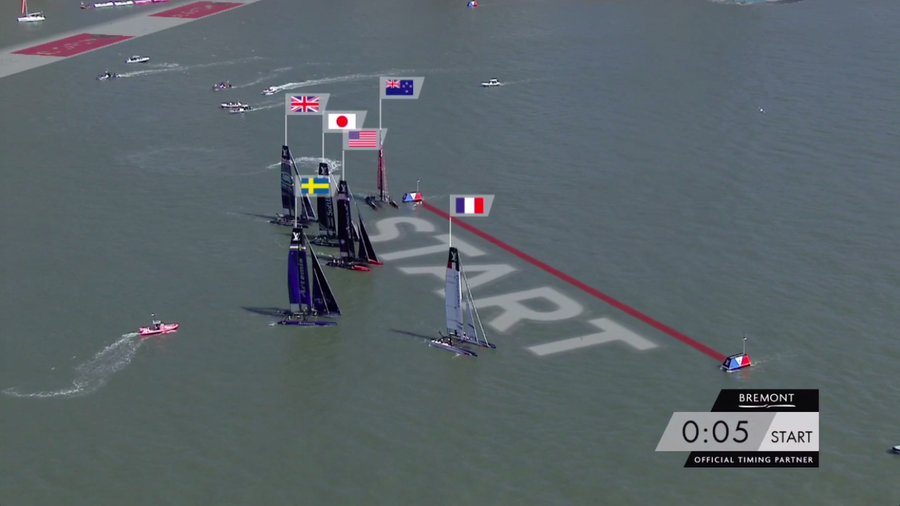
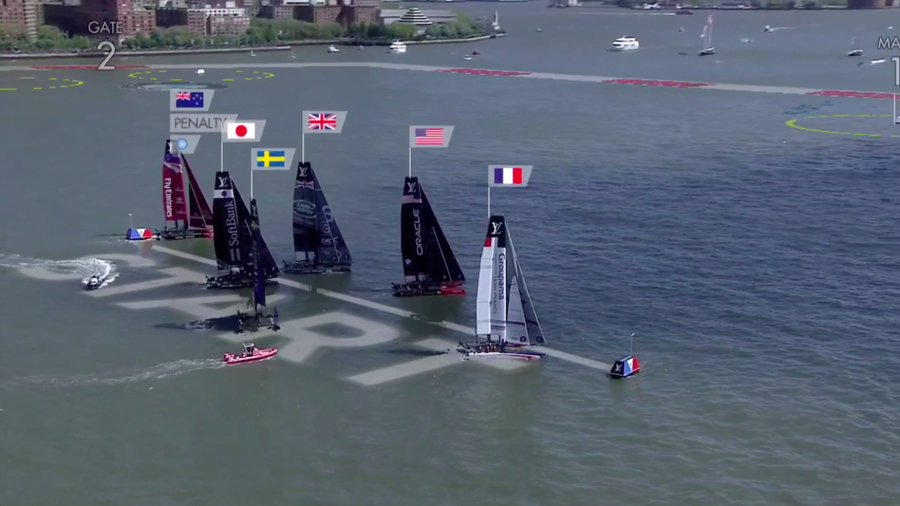
This time it was Emirates Team New Zealand’s turn to get into trouble at the start. Too far downstream and outside the pin end of the line, they hooked the mark’s anchor line. The rest of the fleet took off while the Kiwis struggled to get free. They fought back into contention and then caught a gust on the penultimate leg to win the race and the regatta. Keep your eye on Artemis. They got a bad start, then made things worse by being unable to round Mark 1 properly. They needed to sail back to Mark 1, dropping them to last in Race 3 and last in the regatta.
Video: Emirates Team New Zealand Wins in New York and Stays Atop the Leaderboard
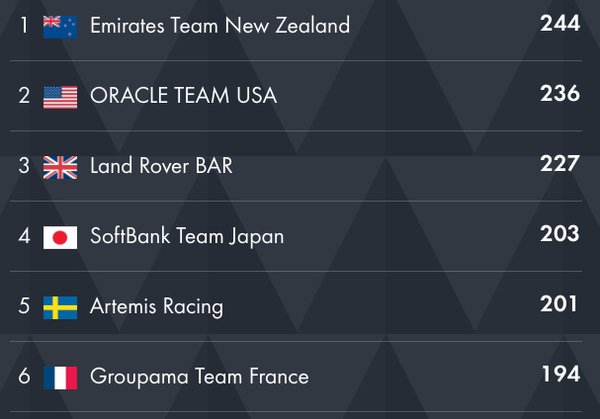
Going into the last race, all six teams had a chance to win the regatta. With four of the teams bunched on the downstream side of the course, struggling to avoid being carried outside the course limits by the current, the Kiwis found a gust and roared off to win the race and the regatta.
(missing photo – 1Feb’17)
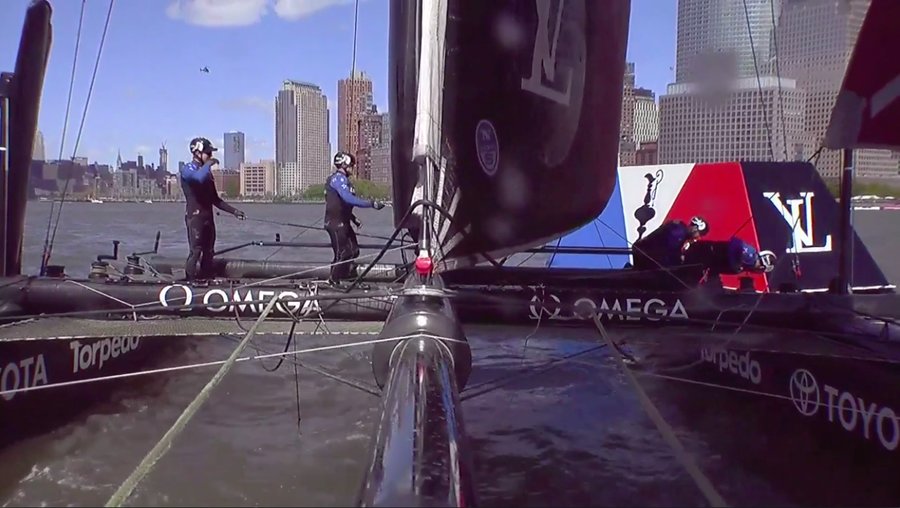
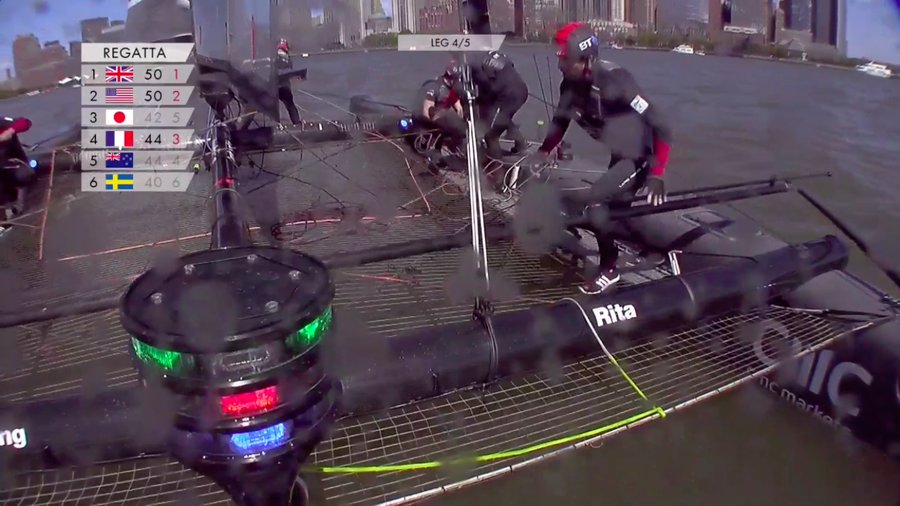
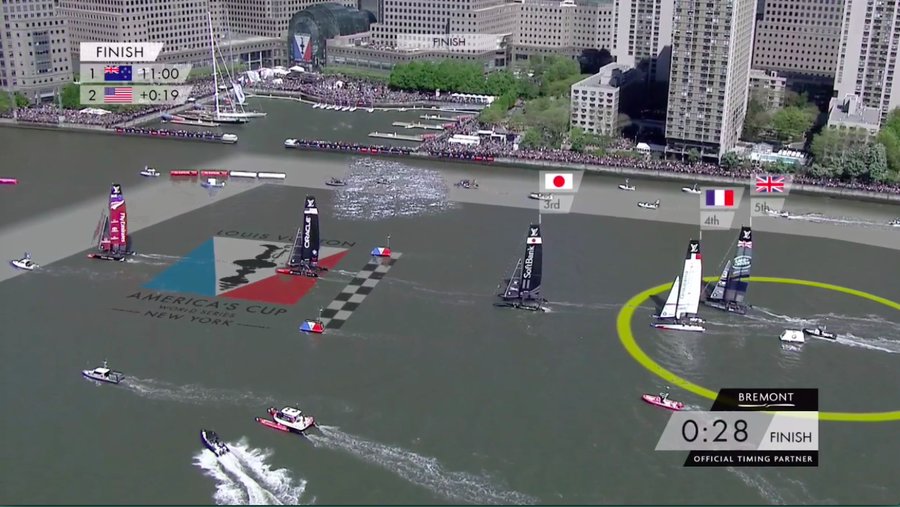
Race 3 Leg 4: The current, flowing from top to bottom of the image, has carried Land Rover BAR and SoftBank Team Japan outside the course limit, giving them penalties. Meanwhile you can see the ripples on the water where the gust has launched Team New Zealand into the lead and on their way to winning the race and the regatta.
Nationality and the America’s Cup – Always Good for a Debate
The debate about nationality rules always stirs passions. Having a strict nationality requirement for the crew would probably boost audience interest, like for the Olympics and the football (soccer) World Cup. But it would also reduce participation and make it hard or impossible for new countries to compete.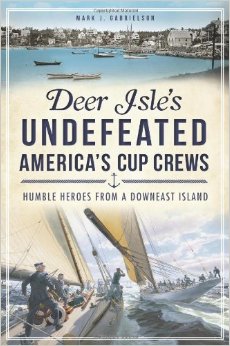
What few people realize is that crew nationality rules were introduced only in 1980 and were dropped 10 years ago. In 1895 and 1899 when American fishermen from Deer Isle, Maine were the crews on “Defender” and “Columbia,” they made news, since crews on US defenders before and after were often Scandinavians.
Charlie Barr, skipper of “Columbia” and later of “Reliance,” was Scottish born. Even “America” had a British pilot on board to navigate around the Isle of Wight in 1851. Barr was a pure professional. He didn’t hesitate to go back to Scandinavian crews for the 1901 and 1903 defenses. Barr would certainly agree with the current philosophy of hiring the best sailors, regardless of nationality.
For the 2017 America’s Cup we have three mostly national teams – Land Rover BAR, Groupama Team France and Emirates Team New Zealand – and three mostly international teams – Oracle Team USA, Artemis Racing and SoftBank Team Japan.
What do you think about nationality requirements? Send me your comments and in a few weeks I’ll report back on what I hear from you.
A Day on the Water with SoftBank Team Japan…and others
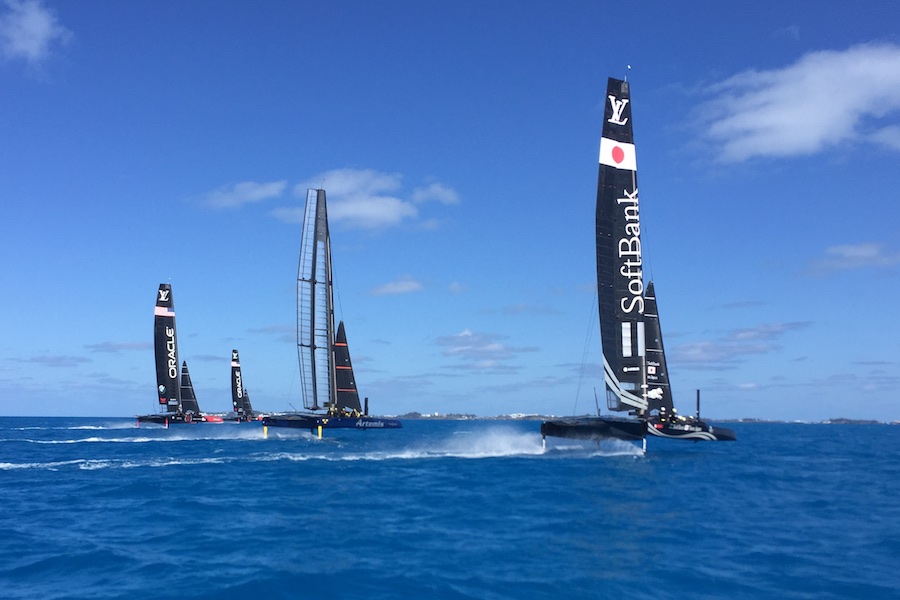
Friday 22 April 2016 All three Bermuda-based teams training off the North Shore
Photo: Jack Griffin
I visited SoftBank Team Japan last Friday and got to spend the afternoon on their chase boat. The team has a real depth of experience from AC34: Dean Barker, Derek Saward, Jero Lomas and Winston MacFarlane were all onboard Team New Zealand’s AC72 in San Francisco. Wing trimmer and sailing manager Chris Draper helmed Luna Rossa. Grinder Simeon Tienpont was grinder and boat captain for Oracle’s AC72. General manager Kasuhiko Sofuku sailed on Nippon Challenge in 2000. The team is developing younger sailors including Japanese team members Yugo Yoshida and Yuki Kasitani and Australian multihull specialist Jason Waterhouse.
Although the team has purchased a design package from Oracle, Nick Holroyd, formerly head of design at Team New Zealand, is making his presence felt, especially with work on board design. Nick was at the cutting edge of the foiling breakthrough during the last campaign.
The team base at Dockyard is growing, with office space and a lounge and kitchen popping up quickly with modular construction.
On the water I saw all three Bermuda based teams out on the water – SoftBank Team Japan, Artemis Racing and, with two boats, Oracle. Looking for long stretches of open water, all four boats headed out of the Great Sound and did several straightline speed runs off Bermuda’s beautiful north shore. No one looked noticeably faster than the others. AC35 will be hard fought and every team is likely to be strong and competitive. SoftBank Team Japan did a few well-executed foiling gybes, but that is to be expected, given that Dean mastered that maneuver long before any of the other helmsmen. Of course, the other teams were also smooth in their maneuvers, but no one should think of SoftBank Team Japan as a “new crew.” A new team, yes, but one with lots of experience and strength.
Yet Again! Burling and Tuke Win their 25th 49er Regatta in a Row
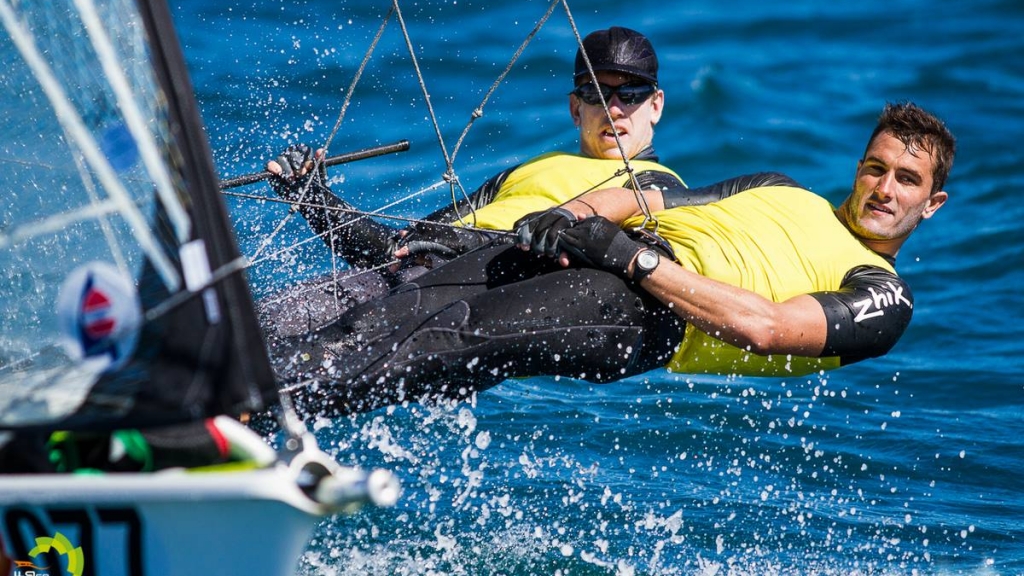
Peter Burling and Blair Tuke continue their unprecedented run of 25 consecutive regatta wins after winning their 4th straight 49er European Championship in Barcelona, Spain. They have not “lost” since they took the silver medal at the 2012 Olympics.
Burling and Tuke had the fleet on the back foot from the start, winning six of the first nine races. Going into the double points medal race, they were 44 points ahead of Australians Nathan Outteridge and Iain Jensen of Artemis Racing, and had an unassailable lead. The margins by which Burling and Tuke have been winning regattas have their competition scratching their heads and wondering what it will take to beat them in Rio this Summer.
The duo have a few days off before traveling to France to make preparations for their next 49er event, the ISAF Sailing World Cup Hyeres, France from 22-26 April. They then jump on a plane direct to New York to rejoin Emirates Team New Zealand for the next event of the Louis Vuitton America’s Cup World Series where they currently lead the overall standings.
Outteridge and Jensen sailed strongly and locked up second place before the medal race but still finished 60 points behind Burling and Tuke. Spaniards Diego Botin and Iago Lopez Marra took third.
- « Previous Page
- 1
- …
- 10
- 11
- 12
- 13
- 14
- …
- 26
- Next Page »