• About
  • America’s Cup Guide
    • AC Guide & Calendar
    • America’s Cup World Series – Race Results & Standings
    • Teams – America’s Cup 2017
    • Rules – America’s Cup 2017
    • old AC Guide & Calendar
  • News
  • Videos
  • Search

Cup Experience

Many America's Cup fans say this is their best source of information.

  • About
  • America’s Cup Guide
    • AC Guide & Calendar
    • America’s Cup World Series – Race Results & Standings
    • Teams – America’s Cup 2017
    • Rules – America’s Cup 2017
    • old AC Guide & Calendar
  • News
  • Videos
  • Search

June 7, 2013 By Jack Griffin

New schedule of America’s Cup racing in July


America’s Cup Race Management released today the new race calendar for July. Remember that the safety recommendations called for dropping two rounds robin to give teams more time for maintenance.  Artemis has announced they plan to launch their new AC72 during July.

“Learning that Artemis Racing is focused on getting to the start line is truly great news,” Barclay said. “I don’t think we can expect them to be ready for the first races but I’m certain the America’s Cup community will support them in every way possible.” 

America's Cup race schedule for July

How to understand the calendar

ACRM has scheduled five rounds robin. It’s virtually certain that Artemis will not race in the first three, so they would be scored “DNC” (did not come) on dates marked with a red “X.” The point would be awarded to the other team. We hope Artemis will be ready to race in the last two rounds robin, but if they are not, the races on dates marked with red “?” will also not be run. That would leave only five days of racing in July – Emirates Team New Zealand and Luna Rossa would race each other on those five days.

Oracle Team USA will run training races with their two boats, so we will see more than five races. You can download the full calendar from ACRM here.

How to understand the Louis Vuitton Cup

Artemis can chose not to race until the semi-finals in August. No one will be eliminated until the end of the semi-final. Even in the original schedule, the rounds robin did not count for much – just the seeding for the semi-finals. With only three teams, the top team from the round robin phase can chose to go straight to the LVC final while the other two teams race in the “best of seven” semi-finals. 

By the way, I was pretty close

Two weeks ago, when we learned that two rounds robin would be dropped, I took a guess at what the new calendar would look like. See my guess and my reasoning here.
 

May 10, 2013 By Jack Griffin

Artemis AC72 crash

Wired magazine’s Adam Fisher has reported that the accident was due to a structural failure when the forward beam broke.

Nathan Outteridge was helming. His father, interviewed on Australian television said,

“They heard a few cracking noises, and then the boat tipped on its side. Before it went right over the mainframe just broke and it collapsed a bit like a taco shell cracking.”

That forward beam had been damaged during tow tests, without the wing in place.

From the report last October:

“The plan was to launch and tow the boat, to put it through its paces at speed, then to step the wing… We launched the boat, towed it to the bridge at speed and on the way back we heard some noises as we were loading the catamaran platform itself. The boat will come out of the water and go into the shed and we will spend the rest of the day thoroughly going through it.”

Photos and TV helicopter video make it clear that the port hull and forward cross beam broke up.


May 3, 2013 By Jack Griffin

Artemis removed the central cockpit from their AC72

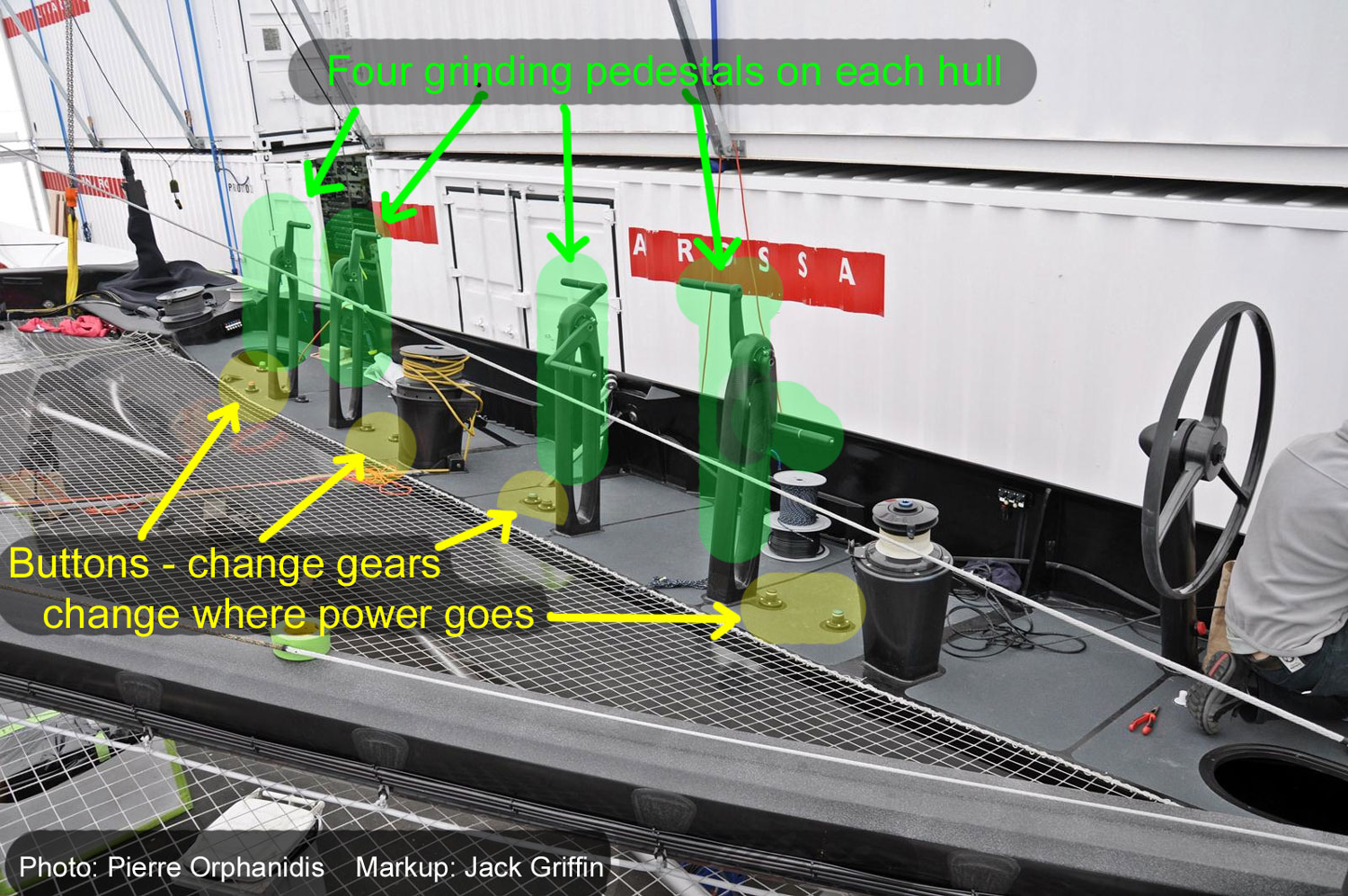
In my earlier newsletter and blog post, I showed the dramatically different layout Artemis chose. While all three other teams put four grinding pedestals on each hull, Artemis opted for a central cockpit with two pedestals and two pedestals on each hull.

America's Cup Artemis AC72

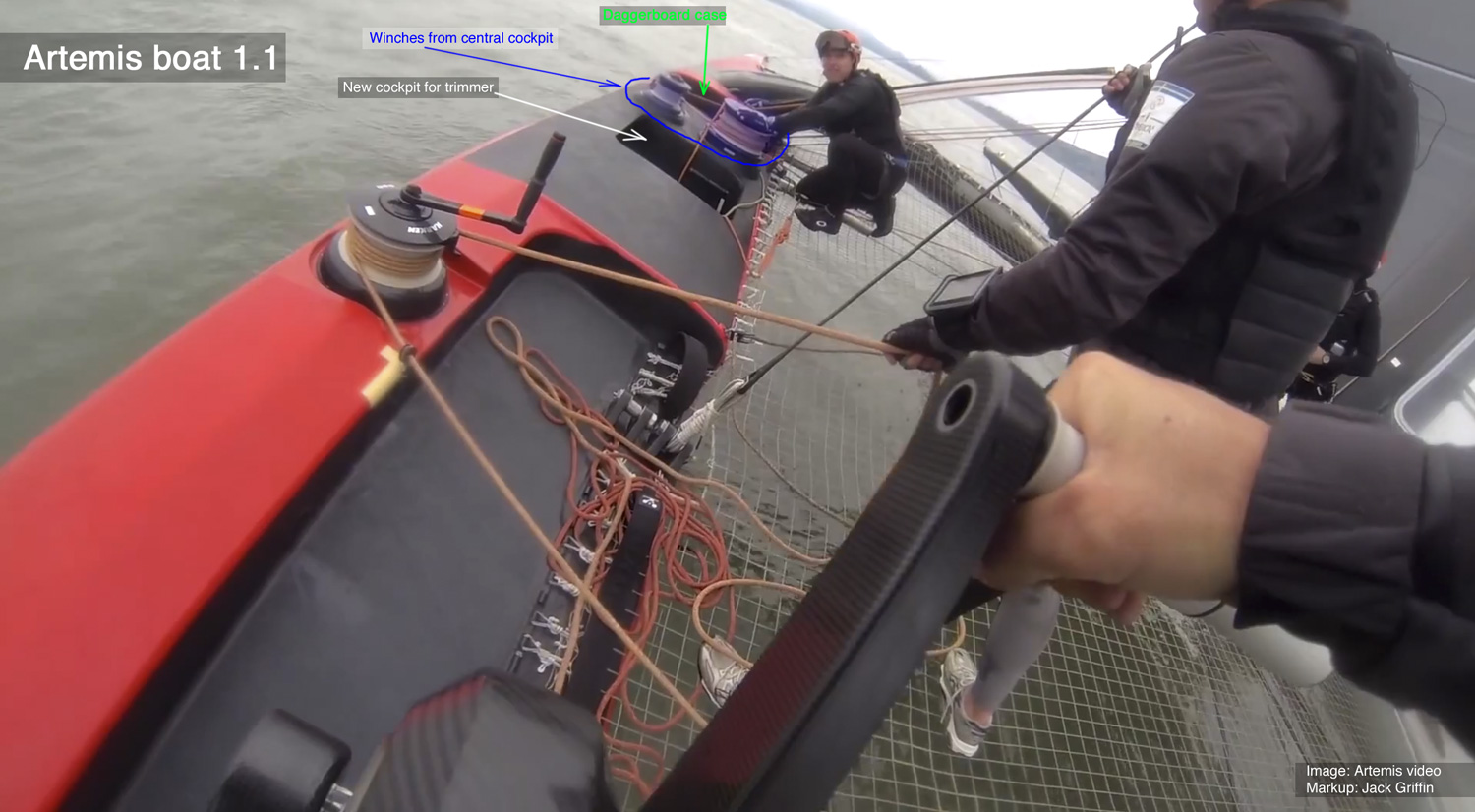
They have now removed their central cockpit, but they have lost the two pedestals – they still only have two pedestals on each hull. They did modify the hulls, adding two winches and a cockpit for a trimmer in each hull. This gives us some clues about what their boat 2 will look like when it launches (in late May?). More photos and details here. And see the original layout compared with OTUSA, ETNZ and Luna Rossa here.

America's Cup Artemis AC72

On board the modified Artemis AC72. The cockpit and the two winches furthest forward are new. Watch their video of the modified boat sailing here.


April 30, 2013 By Jack Griffin

AC72 design update Artemis ergonomics


Center cockpit – gone!

AC72-design-ergonomics-Artemis-cockpit1

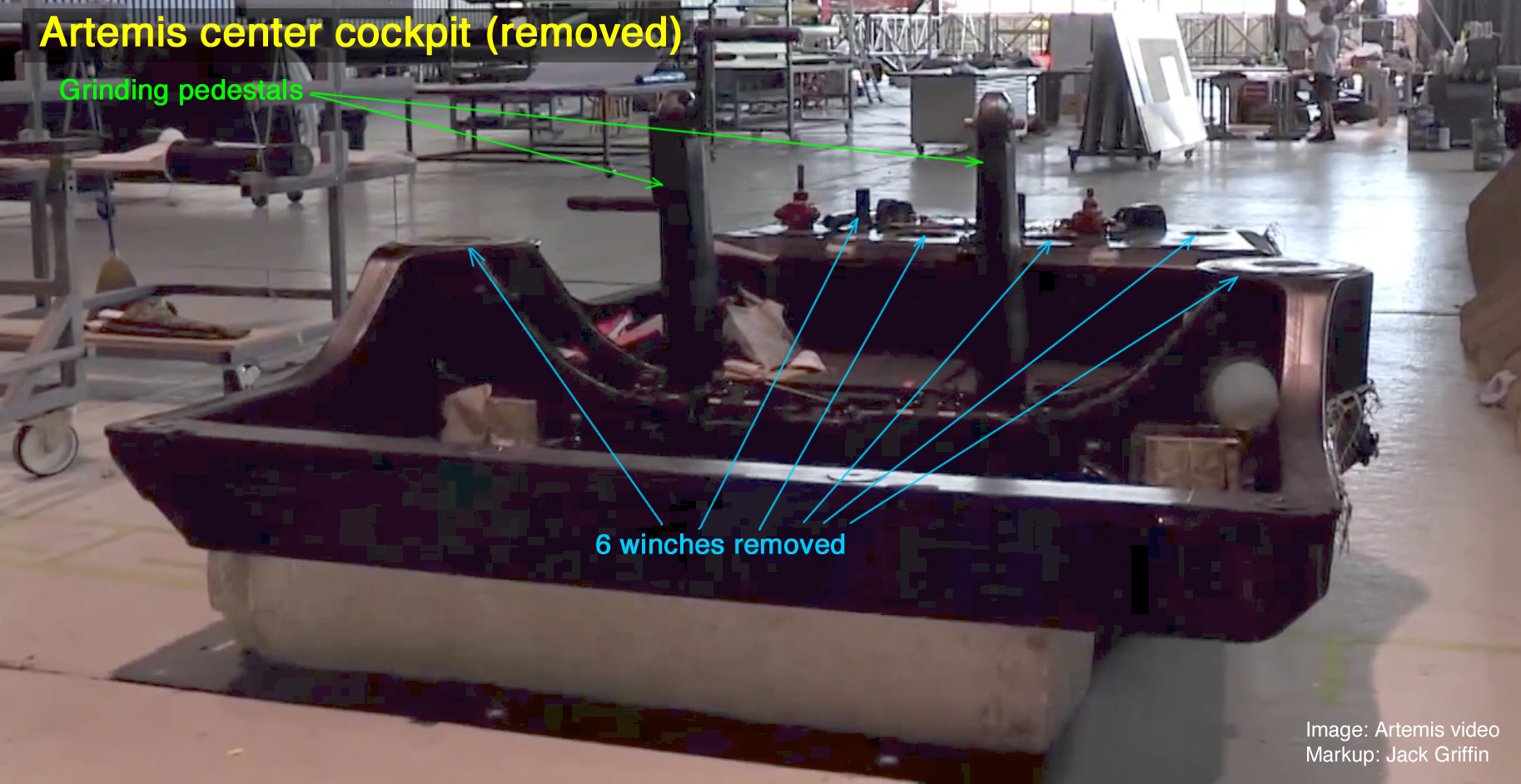
Artemis Racing, Challenger of Record for the America’s Cup, chopped the center cockpit out of their AC72. They repositioned 4 winches that were in that cockpit and eliminated two winches and the two grinding pedestals. Artemis now has a total of four grinding pedestals, compared to eight for all the other competitors.

AC72-design-ergonomics-Artemis-center-cockpit-scrap

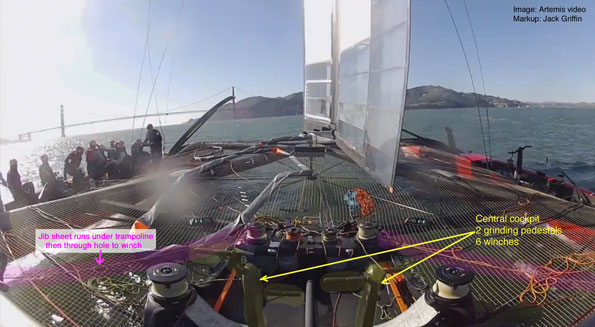
The center cockpit had six winches and two grinding pedestals. Four of the winches have been moved, two to each hull, just behind the daggerboard case. The two grinding pedestals have been removed from the boat – maybe there was no place to put them in the current layout. My prediction: Artemis’s boat 2 will have at least three grinding pedestals per hull, and more likely, four per hull. The AC72 simply requires a lot of power to run all the controls.

AC72-design-ergonomics-Artemis-cockpit-gone

In the photo above we can see that the center cockpit has been removed, making it much easier for the crew to change sides during a tack or gybe. With the center cockpit we used to see the crew, including the helmsman, rolling under the wing to change sides.

America' Cup AC72 design - ergonomics. Artemis boat 1 before cockpit built in hull.

The photo above is “boat 1.0” – before the recent modifications. We see Nathan Outteridge with the tiller in his left hand. He is holding the traveller (aka “wing sheet”) in his right hand. The winch for the traveller is hidden, just forward of Nathan. There is another winch just forward of the crew at the grinding pedestal.

The photo below comes after the modifications – on what I call “boat 1.1.” You can see the two winches (circled in blue) that have been moved from the center cockpit. Just aft of them is the new cockpit for the trimmer. The winch on the red part of the hull was there before. It appears to be used for jib trim. The bigger winch forward of the new cockpit is probably for gennaker trim.

America' Cup AC72 design - ergonomics. Artemis boat 1 before cockpit built in hull.

See deck layouts from all the teams here.


April 17, 2013 By Jack Griffin

AC72 design – ergonomics – grinding stations

Is ergonomics the sleeper issue in AC72 design?

Three AC72 designs. Three ergonomic approaches for layout and crew choreography. The 2013 America’s Cup in San Francisco may be decided by crew work – the short, tight courses will mean a lot of maneuvers. We will look at crew choreography in another article; here we’ll just show the boat layouts.

Oracle Team USA


America's Cup Oracle Team USA AC72

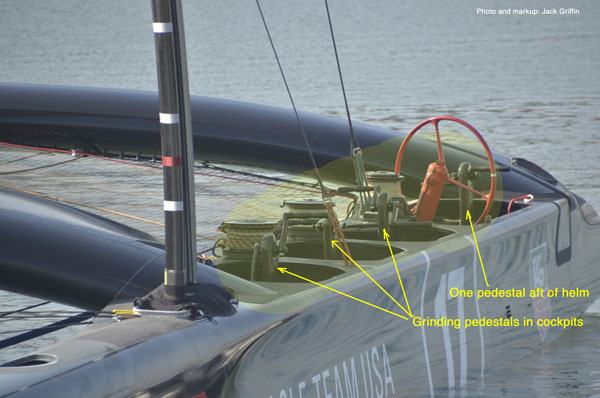
Consistent with their attention to aerodynamics, OTUSA has their grinders face fore and aft, standing in cockpits, to reduce windage. There are four grinding pedestals on each hull. One of the grinding stations is aft of the helm. Advantage: less aero drag. Disadvantage: harder for the crew to get in and out of the cockpits.

Artemis Racing


America's Cup Artemis Racing AC72

Unlike the other three teams, Artemis does not have four grinding pedestals on each hull – only two. Their boat has a central cockpit with two more pedestals and six winches. Advantage: saves the weight of two pedestals on the boat. Disadvantage: reduces righting moment when the crew are not on the windward hull.

Update: Artemis removed their center cockpit. Photos and story here.

Luna Rossa and Emirates Team New Zealand


America's Cup Luna Rossa and Team New Zealand AC72

Luna Rossa bought their design from ETNZ (yes, this is legal under the rules), so both AC72 designs have the same layout, with four grinding pedestals on each hull, facing side to side in a very open layout with no cockpits. All four pedestals are forward of the helmsman. Advantages: The open layout makes it easy for the crew to move from one hull to the other during maneuvers. Disadvantage: more aero drag from crew standing sideways.

Luna Rossa will not build a second AC72 but will continue to develop their boat.  ETNZ has evolved their AC72 design and built second boat, which includes changes to reduce aero drag.


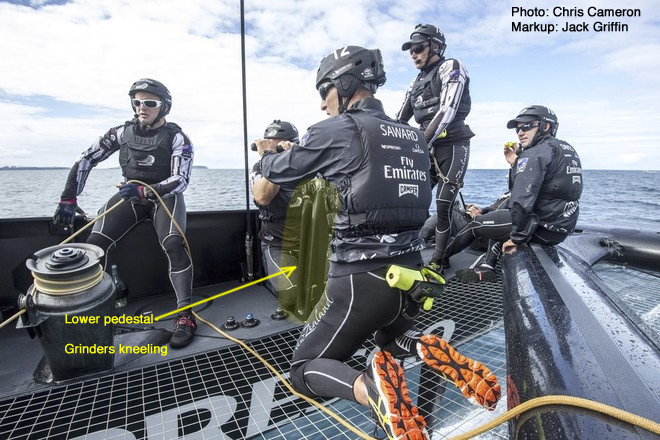
Notice how they have lowered the grinding pedestals in boat two. Advantage: less aero drag when the grinders kneel. Disadvantage: less efficient grinding position.

America's Cup ETNZ lowered the pedestals on their second AC72, to reduce windage

  • « Previous Page
  • 1
  • …
  • 22
  • 23
  • 24
  • 25
  • 26
  • Next Page »
  • About
  • America’s Cup Guide
  • News
  • Videos
  • Search

Copyright © 2026 Cup Experience