Best footage to date of an AC72 gybing on the foils – POV camera under the bowsprit. Watch the starboard board come down, jib come over and the port board go up. At the end Loïck Peyon lets us know what he thinks about it.
Many America's Cup fans say this is their best source of information.
Best footage to date of an AC72 gybing on the foils – POV camera under the bowsprit. Watch the starboard board come down, jib come over and the port board go up. At the end Loïck Peyon lets us know what he thinks about it.

Artemis has now sailed their foiling AC72 six days. They expect two more training days before racing for the first time, against Luna Rossa in the Louis Vuitton Cup semi-final on 6 August. Luna Rossa has almost 80 days in their AC72 including four races.
Artemis trained on the race course and was happy to keep the AC72 inside the course limits going downwind. They are happy with their straightline speed downwind but recognize that they are far behind their competitors in mastering maneuvers. They have self-imposed wind limits – currently 18 knots. They hope to be comfortable with the regatta limit of 21 knots by Tuesday’s race.


Video interview of Nathan Outteridge after 5 days on AC72: good progress, but still a lot to learn to be competitive with Luna Rossa. Artemis lined up their AC72 against America’s Cup defender Oracle Team USA, and were pleased with the results.
Louis Vuitton Cup semi-final begins Tuesday 6 August.
The sailors who must tame the AC72 describe the physical and emotional stress of trying to master these monsters. We will never see them again after this America’s Cup, so enjoy the spectacle now.
Photo: MIchael Creedon Video: Red Bull Media House
They have mastered their AC72, foiling through gybes, sailing deeper angles downwind and showing the superb crew work that may make all the difference in the 2013 America’s Cup in San Francisco this September.
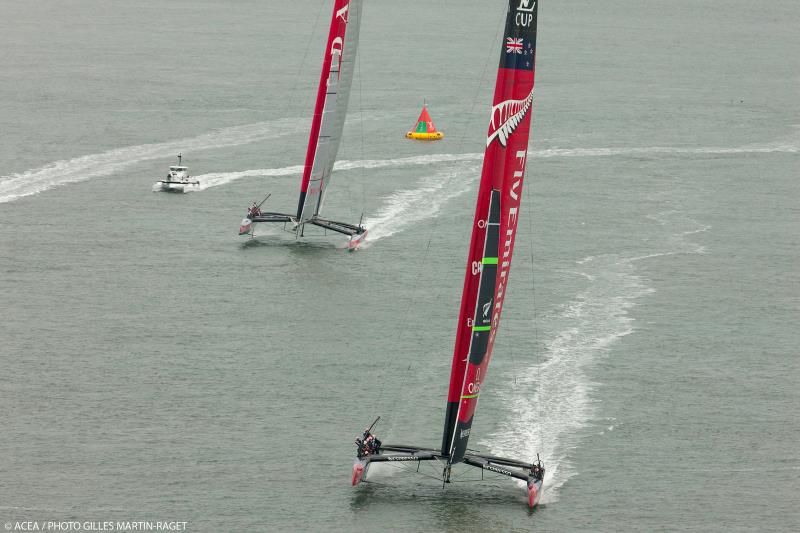
Luna Rossa lost all four races in the July round robin. Emirates Team New Zealand won by margins from 2 minutes 19 seconds to over 7 minutes.
Luna Rossa was in a good position just before the start. They were to leeward of ETNZ, which would have given them the inside lane around the first mark. But they were late accelerating and ETNZ was five knots faster on the short first leg, easily beating Luna Rossa to the mark. The boats turned downwind and ETNZ led by 180 meters after the first gybe.
New Zealand can sail deeper angles downwind – a more direct course to the leeward gate. Luna Rossa must sail “hotter angles” – more upwind and less direct – in order to stay up on their foils.
Course: Seven legs, length: 15.27 nautical miles
Total distance sailed: ETNZ – 18.29 NM; LR – 19.75 NM
Average speed: ETNZ – 25.21 knots (29 mph); LR – 24.5 knots (28 mph)
Top speed: ETNZ – 42.76 knots (49 mph); LR – 39.55 knots (45 mph)
Notice that Luna Rossa sailed almost 1.5 miles more distance with an average speed almost 3/4 of a knot slower.Replay the race on the Cup Experience LiveLine race viewer.
Luna Rossa is the only team that only built one boat. They bought the design from ETNZ, which was allowed by the rules. But ETNZ is sailing their second boat, clearly a more advanced development of the original design.
In spite of losing all their races, Luna Rossa is a strong team. They have been foiling with their AC72 since last October and now have raced four times. Artemis is on a very steep learning curve with their new boat. All this should make Luna Rossa a clear favorite. But until they go out and race, no one knows what will happen. Artemis is on an upward trajectory and has nothing to lose – let’s see what happens in the semi-final!