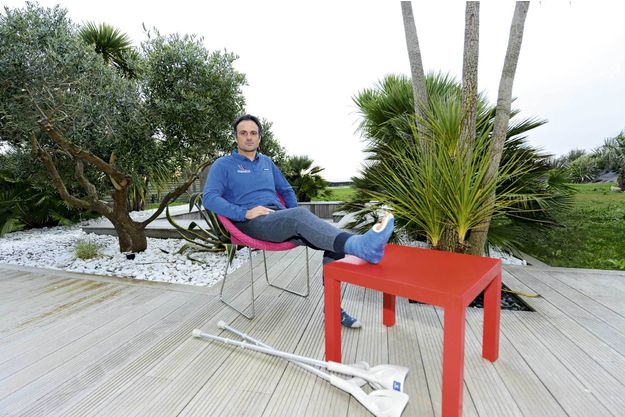
On 30 November 2015 Franck Cammas almost lost his right foot when he went overboard and was struck by the horizontal stabilizer on the rudder of his foiling catamaran. The accident ended his hopes of qualifying for the Olympics in Rio. He will be on crutches until late January 2016, when he will begin four to six weeks of rehab. He was in the office working at a stand-up desk with his design less than 10 days after the accident, but it seems clear that he will miss the first America’s Cup World Series event of 2016, in Oman in February.
The Accident and Rescue
The accident occurred during pre-start maneuvers between the two GC32 cats the team uses to prepare for the America’s Cup. Trying to get a better position on the start line against his teammate and sparring partner Adam Minoprio, Cammas made two sharp turns in quick succession and lost his balance. He went overboard near the stern on the port side and suffered a compound fracture of both the tibia and fibula from the impact with the T-shaped rudder. Coach Betrand Pacé gingerly pulled Cammas into the team chase boat, Cammas’s foot attached only by tendons and arteries. Luckily the arteries were not cut, so he suffered relatively little blood loss. Pacé called for emergency medical services and a helicopter to transport Cammas to the university hospital in Nantes. During the 45 minute flight, Cammas continuously tested the feeling in his foot, reassuring himself that there was no serious nerve damage. At the hospital, waking from general anesthesia after two and a half hours of operation, he was relieved to see that he still had his foot. Professor Gouin, the surgeon, had needed plates and screws to reconnect the bones, as the foot had almost been torn off by the impact.
Safety at Speed
Training videos and this accident raise the question of safety precautions for sailing at high speed. There were no serious injuries when Oracle capsized their AC72 in October 2012, the cockpits protecting the crew. With no cockpits in their AC72, Emirates Team New Zealand lost two crew overboard during the Louis Vuitton Cup racing when they stuffed the bows while bearing away at the windward gate. The design rule for the America’s Cup Class catamarans requires cockpits for the crew as part of the safety measures. The AC45 cats being raced in the America’s Cup World Series are dramatically faster since being modified for foiling. The 32 foot long GC32’s have been clocked at over 39 knots. Sitting on top of the hulls of a foiling cat doing 30 knots or more seems like a very risky idea. Let’s hope there are no more serious accidents. Here is a video that shows the danger. It was shot during training on board BAR’s AC45F.