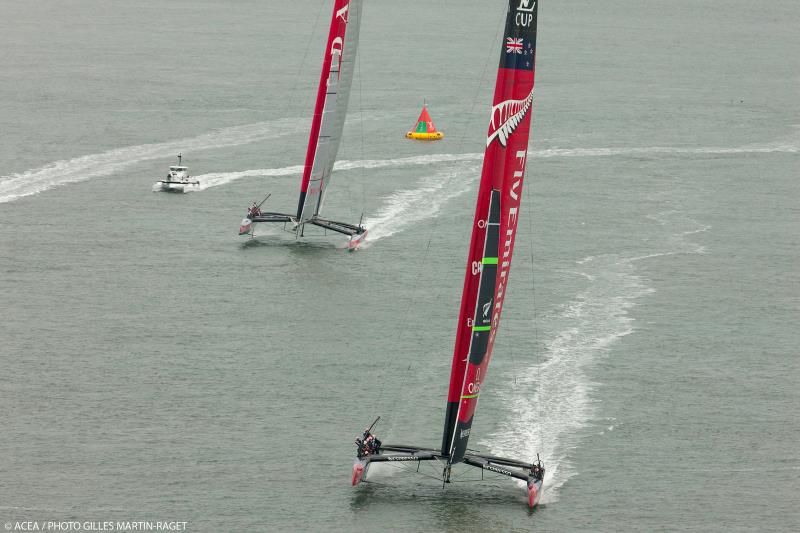
Luna Rossa lost all four races in the July round robin. Emirates Team New Zealand won by margins from 2 minutes 19 seconds to over 7 minutes.
- Better start
- More speed
- Less distance sailed on downwind legs
Better start and more speed
Luna Rossa was in a good position just before the start. They were to leeward of ETNZ, which would have given them the inside lane around the first mark. But they were late accelerating and ETNZ was five knots faster on the short first leg, easily beating Luna Rossa to the mark. The boats turned downwind and ETNZ led by 180 meters after the first gybe.
Less distance sailed on downwind legs
New Zealand can sail deeper angles downwind – a more direct course to the leeward gate. Luna Rossa must sail “hotter angles” – more upwind and less direct – in order to stay up on their foils.
The race performance numbers:
Course: Seven legs, length: 15.27 nautical miles
Total distance sailed: ETNZ – 18.29 NM; LR – 19.75 NM
Average speed: ETNZ – 25.21 knots (29 mph); LR – 24.5 knots (28 mph)
Top speed: ETNZ – 42.76 knots (49 mph); LR – 39.55 knots (45 mph)
Notice that Luna Rossa sailed almost 1.5 miles more distance with an average speed almost 3/4 of a knot slower.Replay the race on the Cup Experience LiveLine race viewer.
First generation boat vs second generation
Luna Rossa is the only team that only built one boat. They bought the design from ETNZ, which was allowed by the rules. But ETNZ is sailing their second boat, clearly a more advanced development of the original design.
What this means for Artemis
In spite of losing all their races, Luna Rossa is a strong team. They have been foiling with their AC72 since last October and now have raced four times. Artemis is on a very steep learning curve with their new boat. All this should make Luna Rossa a clear favorite. But until they go out and race, no one knows what will happen. Artemis is on an upward trajectory and has nothing to lose – let’s see what happens in the semi-final!